- Pick a chapter of the New Testament and interpret it online.
- As you write, think about people you know (or see, or imagine) who are not sitting in the halls of power.
- Think of the author of your particular scripture text not as someone with an advance on royalties in the bank and a Macbook Pro on their lap but as someone with no place to lay their head.
- Use the hashtag #PeoplesCommentary so the rest of us can find it, and so eventually we can sync the whole thing together.
Monday, September 07, 2015
A People's Commentary on the New Testament: Matthew 4
I've been slowly but surely (but mostly slowly) building what I'm calling a people's commentary on the New Testament. So far only one other person, to my knowledge, has joined me in this task. The gist of it? The Scriptures are, by and large, set in a context of oppression and marginalization. Sometimes the audience is the oppressed; sometimes it's the oppressors. Sometimes both audiences are, for all intents and purposes, one and the same. We overlook stuff when we forget that those of us who are comfortable are not necessarily the ones to whom God is speaking words of comfort.
In this project I attempt to notice in the Scriptures a running theme of "striving" (in the words of people's historian Howard Zinn) "against corporate robber barons and war makers, to make ideals [professed in public] a reality — and all of us, of whatever age, can find immense satisfaction in becoming part of that." Here's how it works:


Sunday, July 05, 2015
First Annual Day of Ignorance
I don't mean to brag, but the social media tracking site Klout has deemed me an "expert" in the following:
- Authors
- Bible
- Books
- Christianity
- Churches
- Evangelism
- Faith
- Freelance Writing
- Marriage
- Nonfiction Books
- Publishing
- Religion
- Spirituality
Monday, June 29, 2015
In Praise of 45
In this post:

The Ballad of John and Yoko
"The Ballad of John and Yoko" is a jaunty, jaded journey through Europe. Performed by the Beatles, it's a song of a particular moment, a commentary on his current reality that would come to characterize much of John Lennon's solo work. I have no idea what John is singing at times, but I like this song a lot, particularly Paul McCartney's background harmonies and prominent bass line. On the B side was "Old Brown Shoe," written by George Harrison. More a product of its era, it sounds unlike most Beatles songs, foreshadowing again George's solo work to come. This song was a rocker, and I loved it in a way that made me more open to B sides and other deep tracks to come.

Old Brown Shoe
The other 45 I wore out as a kid featured two songs by, of all people, Nancy Sinatra. Like the Beatles 45, I inherited this from some uncle or second-cousin-once-removed; I would never have found it on my own, because even if it had graced the radio in its first release, those days were more than a decade gone. But its tracks reflect an entirely different popular genre from the Beatles. Hers was what came to be known as "incidental music," the music of camp. "These Boots Are Made for Walkin'" is as American as the Beatles were British; it had a great, catchy bass line too.The boots were surely go-go boots, zipped all the way up to the thigh.
I was, frankly, less likely to flip this 45 over from the A side to the B side, but I was occasionally in the mood for "The City Never Sleeps at Night." There's a 60s-era New York sensibility to this track that I like.
These songs exiss as singular entities, but they also play off each other, A side and B side, to give a fuller portrait of the artist. We consume the A side, we discover the B side. You don't get a B side when you download a song off iTunes; music streaming services leave artists behind after one track in search of something sonically similar. The gateways between music consumption and musical discovery are no longer easily accessible to us.
For my birthday this year, I'm hoping you'll accompany me on a journey of musical discovery. I'm asking you to recommend 45s to me - two songs by artists you appreciate: a popular, released track, along with deeper tracks that are less familiar to the masses but that demonstrate why you're a fan. List them here in the comments, post links to my social media, whatever you like. I hope you'll include in your recommendations a comment on what makes these songs great for you, or a story that explains why they linger in your memory.
I'll expand my musical library based on what you recommend. And if I'm not too intimidated by the technology, I'll build a playlist of all your recommendations on Spotify, so we can discover some great music together. "A splendid time," John Lennon once promised from the B side, "is guaranteed for all."
- Great music.
- Reflections on the music of the 1970s.
- A birthday request.


Monday, June 22, 2015
My Top Five Superheroes (and Why)
My sister asked me, the other day, to list my top five superheroes. She may have been fishing for birthday ideas; she may have been looking for ways to raise her son's standards higher than Hawkeye. Whatever the case, I gladly listed the following (in order):
- Daredevil
- Batman
- Robin
- Captain America
- Moon Knight
- None of these heroes is super-powered at a cosmic level. There is no Superman or Hulk. Captain America is, of course, a "super soldier," and was recently listed among the most powerful superheroes in the Marvel Universe, but his power is essentially enhanced strength, coupled with shocking discipline and focus, and high moral character.
- Only two of these heroes are not in the Marvel Comics universe, and those two (Batman and Robin) are tightly connected to each other.
- Only one of these heroes has a public identity; the rest are in the shadows, although they have a tight network of supporters who know their secret.
- Each of these heroes is associated with a particular place.
Monday, May 04, 2015
Charlie Chaplin: The Cautionary Tale of a Missional Genius
My boss sometimes takes me to bookstores. It's not a habit of mine, oddly enough, even though I'm a book editor and a lifelong reader. It's the sort of thing I'm supposed to equate with nerd heaven, and I do enjoy it, but it's not something I regularly indulge in.
But when my boss takes me to a bookstore, I like to pick something up, especially when the bookstore is an independent. Most recently we went to the Tattered Cover in Denver, a sprawling store in the classic sense. Picture tall shelves with rolling ladders. Picture effusive recommendations from staff. Don't picture music or teapots or "Readers do it spine-out" bumper stickers; true believers don't need such ornamentations. Tattered Cover is a booklover's bookstore.
I wandered the shelves, making mental notes, but the book I bought was in the last place I looked: Charlie Chaplin: A Brief Life is a relatively new biography of the most celebrated actor of the silent film era, the first worldwide celebrity, the icon of a generation. I've watched many (though by no means most) of his films and remember Robert Downey Jr.'s portrayal from the 1990s, but I'd not dug into his story. Now seemed as good a time as any.
 Watch early talkie movies and you'll quickly see how married to the stage the medium was. The actors deliver their lines to the back row of the theater, not to the overhead boom, and their reactions are exaggerated in ways that film doesn't require. It was in the silent era, the age celebrated in the recent film The Artist, that the particular strengths of film as a new medium were explored and tested. One director cut every fourth film cell to his action scenes to give a heightened sense of frenzy; chases and other intricate scenes were carefully choreographed so that the impossible seemed both unavoidable and entirely natural. Early films were short - around eleven minutes on average - but they packed a lot of punch.
Chaplin came up in the theater scene and honed his craft mainly by observation. His capacity for acting drunk became legendary; his lampoons of class divisions were spot-on. But the thing that struck me, the thing that took his work from caricature and spoof to high art and cultural relevance, was rooted in observation. In the first days of his foray into film, after success in vaudeville in Britain and the States,
Watch early talkie movies and you'll quickly see how married to the stage the medium was. The actors deliver their lines to the back row of the theater, not to the overhead boom, and their reactions are exaggerated in ways that film doesn't require. It was in the silent era, the age celebrated in the recent film The Artist, that the particular strengths of film as a new medium were explored and tested. One director cut every fourth film cell to his action scenes to give a heightened sense of frenzy; chases and other intricate scenes were carefully choreographed so that the impossible seemed both unavoidable and entirely natural. Early films were short - around eleven minutes on average - but they packed a lot of punch.
Chaplin came up in the theater scene and honed his craft mainly by observation. His capacity for acting drunk became legendary; his lampoons of class divisions were spot-on. But the thing that struck me, the thing that took his work from caricature and spoof to high art and cultural relevance, was rooted in observation. In the first days of his foray into film, after success in vaudeville in Britain and the States,
 TWEET THIS: We need the student, ironically, to teach us who we are and what we need.
With the release of Kid Auto Races at Venice, his second or third film (the sequence is unclear, but shot within five days of his first film), Chaplin had discovered the character his audience wanted: a Little Tramp, clearly conscious of high society but far removed from its benefits, never welcomed into the in crowd but never defeated by its rejection. He is the outsider looking in, lifting up society's quirks for society to laugh at, making a hero of an outcast.It is this character, who will evolve over the course of many films, who becomes known the world over and who will define the new art form of film.
TWEET THIS: We help those around us to see what must be seen, and we offer hope that what we see will not defeat us.
If that were all there was of Chaplin's story, that'd be a great thing. But Chaplin has sixty-some years to go, and while much of his art is brilliant, much of his life is tragic. The rewards he earned for his careful observation and sympathetic portrayal went to his head. There's little worse than a student who thinks they have nothing left to learn. Chaplin was officious and tyrannical as a director, going so far as to ignore obvious gaffes in his films because he was convinced the audience would never notice them, being as focused as they were on his performance. He was notorious for his treatment of women, most of whom began as muses and ended as used-up lovers. He liked young girls for their innocence, but he repeatedly stole innocence from them. He visited the tenements of his childhood but recoiled at the notion that he shared anything in common with their occupants. And over time this hubris affected his art as well, so that his characters became less a portrayal of Everyman and more a patronizing send up of everyone but himself.
TWEET THIS: There's little worse than a student who thinks they have nothing left to learn.
Chaplin's tragic story has lessons for us as well: our successes in life don't make us better than our neighbors, and the true student of society never graduates. We've never fully uncovered the mystery of our neighbors, and whatever story we might tell on their behalf is never complete. It is always an honor, always a burden, and however we tell such stories, we must always look not just for what's laughable or lamentable in it but for the defiant hope on the other side of it. Without hope, even our most profound portrayals degrade into caricature. Without hope, all comedy degrades into tragedy.
TWEET THIS: We need the student, ironically, to teach us who we are and what we need.
With the release of Kid Auto Races at Venice, his second or third film (the sequence is unclear, but shot within five days of his first film), Chaplin had discovered the character his audience wanted: a Little Tramp, clearly conscious of high society but far removed from its benefits, never welcomed into the in crowd but never defeated by its rejection. He is the outsider looking in, lifting up society's quirks for society to laugh at, making a hero of an outcast.It is this character, who will evolve over the course of many films, who becomes known the world over and who will define the new art form of film.
TWEET THIS: We help those around us to see what must be seen, and we offer hope that what we see will not defeat us.
If that were all there was of Chaplin's story, that'd be a great thing. But Chaplin has sixty-some years to go, and while much of his art is brilliant, much of his life is tragic. The rewards he earned for his careful observation and sympathetic portrayal went to his head. There's little worse than a student who thinks they have nothing left to learn. Chaplin was officious and tyrannical as a director, going so far as to ignore obvious gaffes in his films because he was convinced the audience would never notice them, being as focused as they were on his performance. He was notorious for his treatment of women, most of whom began as muses and ended as used-up lovers. He liked young girls for their innocence, but he repeatedly stole innocence from them. He visited the tenements of his childhood but recoiled at the notion that he shared anything in common with their occupants. And over time this hubris affected his art as well, so that his characters became less a portrayal of Everyman and more a patronizing send up of everyone but himself.
TWEET THIS: There's little worse than a student who thinks they have nothing left to learn.
Chaplin's tragic story has lessons for us as well: our successes in life don't make us better than our neighbors, and the true student of society never graduates. We've never fully uncovered the mystery of our neighbors, and whatever story we might tell on their behalf is never complete. It is always an honor, always a burden, and however we tell such stories, we must always look not just for what's laughable or lamentable in it but for the defiant hope on the other side of it. Without hope, even our most profound portrayals degrade into caricature. Without hope, all comedy degrades into tragedy.

He wandered for some days among the actors and sets without actually being assigned a role. Then the moment came. ... He was not yet the Little Tramp; he was reprising the role of stage villain complete with cravat, top hat, monocle and costume. He had become a "dude" or seedy "toff." In this first film he is insidious, wheedling and oddly threatening. When he kisses a girl's hand, he then goes all the way up the arm. That is an early Chaplin touch. He was rpobably the first to do it on the screen. He already has a full range of facial mannerisms, twitching and smiling and scowling. He also tries out a distinctive walk, the ancestor of a more famous one. ... Moving Picture World said that "the clever player who takes the part of a sharper ... is a comedian of the first water."Observation is the first virtue of comedy and really any meaningful engagement of society. I once heard theologian Soong-Chan Rah tell an audience of missionaries, "If you seek to change a city without first becoming a student of that city, you're not a missionary, you're a colonialist." Acting without first observing is destructive and is ultimately exposed as artifice, as imposition - at its worst, as violence. But critical observation that informs action is almost inherently transformative. The student of a culture, whether that culture is film or fashion or faith or something entirely different, discovers what that culture values, what it fears, what it longs for, what it assumes to be true. Even the culture under consideration is not as aware of these things as its student. We need the student, ironically, to teach us who we are and what we need.

He is already dressed in a distinctive fashion, with clothes that are too small for him. ... He "hogs" the scene, serenely self-confident of his own image and aggressive to those who hinder his presentation of himself. He is bristling with the desire to perform. He gets in the way of the camera filming the races, and resists every attempt of the director to exclude him. He wants to commune with that camera but, more significantly, with the vast and unknown audience that is assembled behind the lens. He sets up a direct relationship with those who are watching him, both mocking and conspiratorial. ... He is absurdly solipsistic, as if to say that only he matters. Only he is worth watching. Chaplin would maintain these sentiments for the rest of his film career.Film is barely a thing, and already Chaplin has knocked down the fourth wall separating the actor from the audience. This is, in fact, what they want - in an impersonal, detached medium Chaplin has supplied personal connection and attachment. The audience identifies with him; they cheer him on even as he violates social protocol right and left. Armed with that trust, Chaplin will go on to expand and ennoble the craft of filmmaking; no longer confined to slapstick, the laughable Little Tramp becomes our guide into a world in which the poor cannot escape poverty because the system is hard-wired against them. Chaplin had learned early on, in his stage career in London, the proximity of laughter to lament. As actress Marie Lloyd told him, "I believe that's what real comedy is, you know, it's almost like crying." And yet this lament that Chaplin led his audience to was never the final word: The young man who overcame adversity to become the most recognizable person in the world would end his films with a kick of the heels and shuffling strut off to his next adventure. In the world Chaplin observed and acted upon, there was always hope and never defeat. This was Chaplin's genius, and it is a good model for those of us who follow Christ to emulate. We study our society, we learn what is laughable and lamentable about it, and we bring it to the foreground so that it is no longer overlooked. We help those around us to see what must be seen, and we offer hope that what we see will not defeat us.
Monday, April 20, 2015
Take Off Your Shoes: The Holy Ground of Airport Security
A woman hasn't seen her sister in eleven years when she learns that her sister is dying. A car accident bogged down her effort to visit, and her sister died before she could get there. She went for a walk on the beach and found a long knotted rope. She started untying the knots, thinking about her sister as she loosened the knots and untangled the rope. Six hours later the rope was neatly collected and she was ready to take her place as the family matriarch.
She hasn't flown in a plane since 1987. She just got married, so all her identifications show her maiden name. Her husband, a merchant marine, is at sea for two weeks. Her flight was, of course, booked at the last second. But you have to go, to return and be restored to your place in the family, as much for your family as for you.
I want to call my sister, to tell her I won't let the years separate us. I want to cull the herd of my life so I can quickly go where I need to be in a hurry. I want to say something more profound and resonant than "She's in a better place" and "She's looking down on you in love" or "I'll be praying for you," as much because that can't really be comforting, even though she's clearly comforted by it, as because I must be a better wordsmith, a more sophisticated thinker, than that.
I've got nothing. I just offer my prayers and nod in agreement. Her sister is in a better place than the place where she contracted lung cancer and lost touch with her sister for more than a decade. She is looking down in love, because love is the thing that survives death.
We're in line together at security, and the TSA agent is wonderfully compassionate, even though she thought we were a couple when clearly I'm younger and could do better, right? And then we are through security and she's going to concourse N and I'm going to concourse C. I say goodbye and she doesn't hear me because she's in her own head. I haven't made a friend; I've just made my way through the security line. And it's not even 7am yet. But the world spins madly on, and the finger of God holds the axis steady, and my shoes are off, because the place where I am standing is holy ground.
Sunday, April 05, 2015
Throw Down Your Ace in the Hole: Happy Easter from Loud Time
Monday, March 23, 2015
A People's Commentary on the New Testament: Matthew 3
The Scriptures are, by and large, set in a context of oppression and marginalization. Sometimes the audience is the oppressed; sometimes it's the oppressors. Sometimes both audiences are, for all intents and purposes, one and the same. We overlook stuff when we forget that those of us who are comfortable are not necessarily the ones to whom God is speaking words of comfort.
Hence the ongoing project I'm working on:
His message was simple and austere, like his desert surroundings. John the Baptizer, born into privilege as son of a temple priest, was also a miracle child, having been born to parents who had long before given up on having children. His character here demonstrates the turbulent religious climate at the time of Jesus' ministry, as he rejected the formal religious system of his father and embraced the ascetic lifestyle ("a diet of locusts and wild honey") and fiery message of a renegade prophet: "Prepare for God's arrival! Make the road smooth and straight!" Here he references the prophet Isaiah:
Every valley shall be raised up,
every mountain and hill made low;
the rough ground shall become level,
the rugged places a plain.
And the glory of the Lord will be revealed,
and all people will see it together.
(Isaiah 40:4-5)
While these words allude to a great leveling in society - bad news, generally, for people who had secured power for themselves - its context is a message of comfort: "Speak tenderly to Jerusalem," Isaiah is instructed by God. It is worth remembering at all times that God offers good news to people who struggle and suffer; God's words of confrontation always have a larger context of loving concern.
TWEET THIS: God's words of confrontation always have a larger context of loving concern.
That John drew diverse crowds is noteworthy, both as a demonstration of the religious upheaval taking place, and as a context for Jesus' first public display of his divine mission.
When John realized that a lot of Pharisees and Sadducees were showing up for a baptismal experience because it was becoming the popular thing to do, he exploded. As is often the case, sincere acts of repentance often degrade into pious performance; much as politicians who make a show of going to church, or scandalized televangelists who make a tear-filled public confession of scandalous behavior and immediately return to fundraising, such appropriations of earnest acts of commitment simultaneously buttress the public profile of people in power while also subverting the enduring value of more authentic demonstrations. John's response is telling: "Descendants of Abraham are a dime a dozen. What counts is your life." As Jesus himself will affirm, John declares that public spectacles and public behavior alike are suspect; our character and commitment are revealed in small, even secret ways, far removed from any derived benefit.
“The main character in this drama — compared to him I’m a mere stagehand — will ignite the kingdom life within you." As powerful and momentous as John's ministry was, it was effectively remedial; the more proactive, constructive, directive ministry was still to come, through Jesus. "He’s going to clean house — make a clean sweep of your lives." If John represents a renaissance of the prophetic tradition, with strong confrontational language leading to a renewed commitment to justice and social parity, then Jesus (at least according to John) represents revolution, a total overhaul of the social order.
Note that John sees himself, and consequently his ministry, as subordinate to Jesus. He is "a mere stagehand" for the main act to come. And when Jesus ultimately presents himself for baptism, John objects: “I’m the one who needs to be baptized, not you!”
“God’s work, putting things right all these centuries, is coming together right now in this baptism.” Why would Jesus, self-conscious of his unique mission, accept a baptism of repentance by John, who himself admits his inferiority? A recurring theme in Jesus' teaching (and, importantly, his visions of the end) is the great leveling of Isaiah 40, the flattening of social hierarchies. Guests at the wedding banquet that represents the end of the age range from the powerful to the penniless; moreover, men and women of ill repute and little to no means made regular appearances alongside Jesus at meals throughout the Gospels. It isn't the pecking order in this baptism that is important to Jesus; it's "God's work [of] putting things right" that matters. In this respect, both John the Baptizer and Jesus the Messiah are playing roles in an epic story; their vocation is fulfilled not by achieving status but by playing their part well.
“This is my Son, chosen and marked by my love, delight of my life.” Jesus may be playing a part in a story, but he is the central character in it. He will have his credentials repeatedly challenged by powerful people in scenes to come, but here his credentials are clear: God himself participates in Jesus' baptism, which becomes effectively an ordination, a king's anointing:
"You are my son;
today I have become your father.
Ask me,
and I will make the nations your inheritance,
the ends of the earth your possession. ...
Therefore, you kings, be wise;
be warned, you rulers of the earth.
Serve the Lord with fear
and celebrate his rule with trembling.
Kiss his son, or he will be angry
and your way will lead to your destruction.
(Psalm 2:7-10)
TWEET THIS: Jesus' mission is good news for the people, but bad news for those who have achieved power and status.
This first public declaration of Jesus' mission is good news for the people, but once again it is bad news for those who have achieved power and status, often on the backs of people they were sworn to serve and protect. Jesus' anointing is a warning to "you rulers of the earth": they, like everyone else, are subject to the ultimate Sovereign God of creation, and their rejection of Jesus - and the social order he represents - will be counted as treason, and dealt with accordingly.
A People's Commentary on the New TestamentIn this project I attempt to notice in the Scriptures a running theme of "striving" (in the words of people's historian Howard Zinn) "against corporate robber barons and war makers, to make ideals [professed in public] a reality — and all of us, of whatever age, can find immense satisfaction in becoming part of that." I invite you to undertake it as well:
- Pick a chapter of the New Testament and interpret it online.
- As you write, think about people you know (or see, or imagine) who are not sitting in the halls of power.
- Think of the author of your particular scripture text not as someone with an advance on royalties in the bank and a Macbook Pro on their lap but as someone with no place to lay their head.
- Use the hashtag #PeoplesCommentary so the rest of us can find it, and so eventually we can sync the whole thing together.
Tuesday, March 17, 2015
Dangerbooks! Vulnerable Faith by Jamie Arpin-Ricci
I had the privilege, some time ago, of editing Jamie Arpin-Ricci's book The Cost of Community. I had been introduced to Jamie by my friend Adrianna Wright, and we had the opportunity to travel to Haiti together on a learning mission hosted by Haiti Partners and funded by InterVarsity Press, which had recently published another great book, Following Jesus Through the Eye of a Needle, by another good friend, Kent Annan. Publishing is not always so friendly, so familiar, but when it is, it's particularly rewarding. Jamie has remained a friend (at a distance, as he lives in community in Manitoba and doesn't venture out much), and so I was honored to be invited to review his latest book, Vulnerable Faith, this time published by Paraclete Press.
Jamie gets right to it in this book, challenging a common but distressing element of contemporary Christian faith: "cheap faithfulness."
 Cheap faithfulness is only one manifestation of a larger crisis in the human condition, one that causes us to lean toward cheapness in all our relationships and away from the more risky, but more rewarding, relationships with God and others characterized by vulnerability and authenticity. Vulnerable Faith is, essentially, a conversation about the nature of truth and our essential distance from it at all times, thanks to our regrettable finiteness. A fear of death inspires in us a sense of self-preservation that puts us at odds with one another, at odds with God. The best we can hope for, as this sense of self-preservation lives in us, is what Scott Peck calls "pseudo-community," a kind of conspiracy of pretense underlying all our relationships, and ultimately a self-deception that renders us other even from ourselves. Jamie demonstrates this problem by looking at the life of none other than St. Patrick, the manliest of saints.
Cheap faithfulness is taking the name of Christ as our identity without requiring the renunciation of self and selfish ends. It is seeking full intimacy with God yet giving little, if any, commitment. It is about negotiating terms with Jesus, as though we have anything at all to bring to the table. It is an abuse of love no better than trying to achieve the pleasures of intimacy by using another person for cheap sex. (Vulnerable Faith, p. 22)

If you would put half as much effort into being who you could truly become, rather than trying to be who you think everyone else wants you to be, you could become a man people would follow. (Calpurnius, father of St. Patrick, to his son, aged sixteen, p. 36)So few of us are our true selves; perhaps this is why so few of us are saints. To be a saint is to be other than what we are, in our striving, self-protection and self-deception. But in another sense, to be a saint is to be finally what we were created to be, what we are underneath our own fortresses of artifice and pretense. We have lost sight of ourselves; Only God can understand us now. Only God can save us. And how he saves us? We're not going to like it. "The cross is an instrument of death" (pp. 29-30). Taking up the cross of Christ involves the emptying of our lives of all pretense to be replaced with the Truth. The embrace of truth is not a conceptual, intellectual thing, but an embrace of Jesus who is the truth and who gives his life for us and calls us into a daily martyrdom from which we are resurrected as better, humbler, more compassionate, saintlier versions of ourselves. Jamie calls this the "martyrological" life. "Because Jesus embraced this emptiness and because it glorifies God," Jamie assures us, "it is not a punitive emptying, but a meaningful and hopeful one, promising that something far greater will fill us" (p. 93): vulnerability, authenticity, humility, born of the grace and truth of Christ. In this respect, the cross is not just an event - the salvific work of Jesus - it is also an ethic. We often think of dying to ourselves as living self-sacrificially, and that's a part of it. But as Jamie explores in this book, dying to ourselves is also more existential than that, more fundamental than that. After all, we can live self-sacrificially and still be incredibly pretentious, even violently judgmental. But dying to ourselves? This is the type of martyrological life uncovered in, of all things, the recovery movement. We die to ourselves by admitting our incapacity to kill it at life. We acknowledge the thing we love, cling to, the thing that is slowly killing us but that we have entrusted our security to. Alcohol, food, gambling, sex, sin, whatever, these are presenting problems of an underlying issue: our fear of our own mortality, our own vulnerability. We are on an undiverting path toward death and we can't handle it. We are contributing to our own demise and it's freaking us out. By the grace of God we are delivered of this fear of death (as if we are ever delivered from the fear of death without first going through it), emptied of our pretensions and self-deceptions (as though we are ever rendered invulnerable to such things). On the far side of the cross we are no longer diverted from the mission of God, which has as its goal a world rightly ordered under the sovereignty of a good God of love, with all of creation demonstrating loving mutuality without pretense or self-protection. The poor among us are no longer "the poor" but brothers and sisters who need our help; the struggling among us are no longer objects of our impatient pity but those we struggle with. While most of Jamie's book is personalized, it is never individualized: indeed, he demonstrates very effectively that reconciliation between people is prior to reconciliation with God, according to the gospel of the Bible. This isn't works-righteousness; it's the nature of our healing. Jamie tells the story of a husband who was confronted for flirting with another woman; his wife's cross to bear was neither to silently endure this indignity nor to cut ties and forge a new life - either of which is commonly prescribed in our highly transactional, hyper-individualized age. Her cross to bear was to leave her husband for a time, to endure the embarrassment and complication of separation, and to pray for her husband to die to himself. And she and her husband, though separated from each other, were accompanied in their cross-bearing by their supportive community. This was a communal challenge, and though in this instance it ended tragically, it still demonstrates the fundamentally plural nature of the Christian life. "The relationship," Jamie observes, borrowing from the sponsor relationship in Alcoholics Anonymous, "is not about positional authority but dynamic mutuality." To be Christian is, above all, to not be alone: we are led by a God who promises to never leave us or forsake us, but we are also bound to one another by our crosses. Jamie's portrait of Patrick and his transformation, from spoiled child of privilege to patron saint of Ireland, is insightful and arresting. Not only is Patrick's story dramatic enough to bear telling, it's also existentially significant: there is more to his story than the facts--the people, the place, the things. Patrick is a saint, but he is also us. And this is both bad news and good: We are as vulnerable as was young Patrick, but we are also as capable of great things as he, as available to transformation as he. We are us, but we are also, somewhere in the DNA of us, saints.
Friday, February 27, 2015
The Rise of the Remedial Christian
I attended a church service recently (bully for me) as part of our ongoing quest to find a "church home" in Colorado Springs. The search here is something akin to going to the grocery store for cereal when you don't really know what you have a taste for: Colorado Springs is the land of evangelical ecclesiastical overchoice, which, I assure you, can be paralyzing and perplexing.
(My friend Sean Gladding, on loan to the United States from England, once complained about the cereal aisle: "How many combinations of white flour and sugar do we really need?!?" He's a foreigner, folks; cut him some slack.)
My antennae may be up a little higher these days as I visit these churches; I notice little quirks and tics of each preacher, I scrutinize song choice, I look for typos in the bulletins. Admittedly, I'm not my best self in these moments. But at this particular church service I noticed something interesting: the pastor started to say something, caught himself, took a deep breath, and went for it:
"I think ... it's possible, actually ... that Jesus ... might have ... maybe ... been a progressive?"Nobody stormed out of the sanctuary, to my knowledge, and I think he still has his job - even here where "progressive" seems to be a euphemism for "heretic." Seriously. I was forewarned by a friend never to say anything nice about President Obama. Anything. Even "Nice suit, Mr. President" requires a pronounced tone of sarcasm. I've only scratched the surface of the broad swath of Colorado Springs churches, so I'm sure progressive is not a universal byword here. But it did strike me how scandalous a mere word could be, how damaging a label it can become. Meanwhile, I recently read a portion of Martin Luther King Jr's letter from Birmingham Jail for a video project some friends of mine put together for Martin Luther King Day. (You can watch the fifty-minute video here.) The portion I read was in praise of my wife's great uncle Ralph McGill and other "white moderates," whom King acknowledged had taken brave stands against segregation and for the reconciliation of the South. "They are still all too few in quantity," King wrote, "but they are big in quality." It struck me at the time (you can read my reflections here) that King didn't call these folks "white radicals" or "white progressives"; he referred to them as "white moderates." This is significant, I think: championing the civil rights of another human being isn't a radical or even progressive stance; it's fundamentally moderate, almost the least a person can do. And then I went to a brief conference to discuss the church's relationship to the millennial generation, which was described at one point as a mosaic of "nomads, prodigals and exiles." All nouns. All labels. All fixed identities which can quickly degrade into caricature. It's saying a lot about a person to say that they are a nomad, or an exile, or a progressive, for that matter, It says a lot about a person to call them (even to call yourself) a conservative, or an evangelical. It simultaneously sums a person up and says more about them than is possible to know. When adjectives (such as "progressive" or "conservative") become nouns, beware. When words are applied to human beings that are better applied to abstract concepts (such as "exile"), we are in danger of abandoning our humanity and converting ourselves into abstractions. Abstractions can be helpful, as means to an end, and so conversations about progressivism and conservatism, nomadicism and the like, and how they are embraced and engaged among various demographics can yield helpful insights. But people are not abstractions: they are not means to an end. They are not even ends, really; they are active subjects, in constant flux. If anything, they are middles, or beginnings. In any case, to quote the great Ferris Bueller, "Isms in my opinion are not good. A person should not believe in an ism; he should believe in himself." Good point there. We are more than the isms that enthrall us, and we should be wary of where our isms take us. A progressive or a conservative becomes a caricature to her ideological opposites: to the progressive, all conservatives are probably racist, xenophobic, homophobic tyrants; to the conservative, if you're a progressive, you must have been at some point dropped on your head. But more than that, a person who has been absorbed into an ism will find herself with strange bedfellows, uncomfortable allies, Facebook friends who demand explanations but are without excuse. Who hasn't winced at the careless comment of an ideological ally, knowing that we're somehow going to have to excuse or defend them for saying it? We are tempted to surrender our identities to our isms, and once we've done so, we've succumbed to idolatry and become accessories to all kinds of evil. The kingdom of God will allow no isms. There are Jews and Greeks in the kingdom of God, but there is no Jew nor Greek. There are men and women in the kingdom of God, but there is no male or female. There is no slave or free in the kingdom of God, because slavery exists only under the auspices of our isms, and our isms have no place in the new creation. It is easier for a camel to fit through the eye of a needle than for our isms to accompany us into the kingdom of God. That's why I propose a new category of Christian, one that abandons the artificial polarities of conservatism and progressivism, which are far too often partners in pointlessness. Please join me in welcoming ... the rise of the remedial Christian! There's nothing magical about the word remedial, but as a modifier of Christian I like it very much. It suggests what Dr. King declares: that submitting and subjecting ourselves to the right thing, even in the face of hostility or marginalization or ridicule or violence, is nothing terribly special. It's not especially progressive to say that all human beings are vested with the same God-given rights. It is at best moderate but in fact remedial, almost the least we can do. Similarly, it's not especially conservative to acknowledge the fundamental responsibility of each person for their own decisions, though it's claimed as a tenet of conservatism. Such an idea is remedial, roughly akin to stating the obvious. Remedial implies something basic, so basic that it's easily overlooked and often undervalued. It implies something that resolves a problem not by creating something new but by going back to the beginning. "This is a football" is remedial coaching; with it Vince Lombardi kicked off each season with a reminder that the basics are what's important, and everything else builds on it. Remedial has etymological connections to remedy, which implies healing, relief. Ferris's dad, believing him to be sick, encouraged him to "wrap a hot towel around your head ... then make yourself some soup, get a nap." Not the cure for cancer, but then again, Ferris didn't have cancer. It was a remedial prescription, and everytime a Gen-Xer feels a fever coming on, it's one of the first things that comes to mind. Remedial is a good thing in the same way that reform (a la "Reformation") is a good thing, in the same way that repentance (as in "Repent! For the kingdom of God is near!") is a good thing. But in the same way as repentance, remedial is nothing to brag about. "Amazing grace ... that saved a wretch like me" is a statement of remedial faith: its author recognized that grace is not an achievement but a gift. We can't be boastful or judgmental when we're being remedial, when we understand ourselves as remedial. It just doesn't sound right. It's hard to pull off blustery entitlement on a news show panel when the caption under your name reads "Remedial Christian." Now, I recognize that what I'm proposing is a little silly, but then again, silly proposals aren't necessarily bad. Consider when Naaman, a general of the army of Aram, found himself leprous. He sought help from the prophet Elisha, who told him to take seven baths in the river Jordan. Naaman was offended at the lack of complexity in this proposed remedy, but his servant challenged him:
“Father, if the prophet had asked you to do something hard and heroic, wouldn’t you have done it? So why not this simple ‘wash and be clean’?”Remedial, yes, but it worked: Naaman took seven baths and came out completely healed. Imagine how much healing might be available to us if we set aside our commitments to complexity, our idolatry of our isms, and just allowed ourselves and each other to be what we are already: basic people, all trying to figure it out together. Enjoy it while it lasts, though. As soon as we embrace "remedial Christianity," we'll start crafting a new idol: remedialism. God help us, every one. ***
Sunday, February 01, 2015
A Prayer for Super Bowl Sunday by Walter Brueggemann
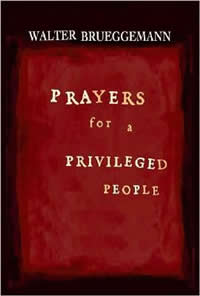
Leave it to Walter Brueggemann to have both the moxie and the skills to sacralize Super Bowl Sunday, which he does in his 2008 collection Prayers for a Privileged People. "It is no challenge to me," he writes, "to rethink myself along with other privileged believers, even if our privilege tends to work against openheartedness." It's no challenge to him because he recognizes that he is a person of privilege, enjoying benefits accruing to his ethnicity, gender and social class that were woven into the cultural fabric years, decades, even centuries before he was born. That's all well and good, but what could the Super Bowl possibly have to do with social privilege?
Read on and find out. If you have a little moxie, you might even pray it.
* * *
 The world of fast money,
and loud talk,
and much hype is upon us.
We praise huge men whose names will linger only briefly. We will eat and drink,
and gamble and laugh,
and cheer and hiss,
and marvel and then yawn. We show up, most of us, for such a circus,
and such an indulgence.
Loud clashing bodies,
violence within rules,
and money and merchandise and music. And you - today like every day -
you govern and watch and summon;
you glad when there is joy in the earth,
But you notice our liturgies of disregard and
our litanies of selves made too big,
our fascination with machismo power,
and lust for bodies and for big bucks.TWEET THIS: Our life consists not in things we consume but in neighbors we embrace. Walter Brueggemann, Prayers for a Privileged People
And around you gather today, as every day,
elsewhere uninvited, but noticed by you,
those disabled and gone feeble,
those alone and failed,
those uninvited and shamed.
And you whose gift is more than "super,"
overflowing, abundant, adequate, all sufficient. The day of preoccupation with creature comforts writ large.
We pause to be mindful of our creatureliness,
our commonality with all that is small and vulnerable exposed,
your creatures called to obedience and praise. Give us some distance from the noise,
some reserve about the loud success of the day,
that we may remember that our life consists
not in things we consume
but in neighbors we embrace. Be our good neighbor that we may practice
your neighborly generosity all through our needy neighborhood.
and loud talk,
and much hype is upon us.
We praise huge men whose names will linger only briefly. We will eat and drink,
and gamble and laugh,
and cheer and hiss,
and marvel and then yawn. We show up, most of us, for such a circus,
and such an indulgence.
Loud clashing bodies,
violence within rules,
and money and merchandise and music. And you - today like every day -
you govern and watch and summon;
you glad when there is joy in the earth,
But you notice our liturgies of disregard and
our litanies of selves made too big,
our fascination with machismo power,
and lust for bodies and for big bucks.
elsewhere uninvited, but noticed by you,
those disabled and gone feeble,
those alone and failed,
those uninvited and shamed.
And you whose gift is more than "super,"
overflowing, abundant, adequate, all sufficient. The day of preoccupation with creature comforts writ large.
We pause to be mindful of our creatureliness,
our commonality with all that is small and vulnerable exposed,
your creatures called to obedience and praise. Give us some distance from the noise,
some reserve about the loud success of the day,
that we may remember that our life consists
not in things we consume
but in neighbors we embrace. Be our good neighbor that we may practice
your neighborly generosity all through our needy neighborhood.
Subscribe to:
Posts (Atom)
Both Inspiration and Cautionary Tale: Excerpts from Middling
What follows is an excerpt from the Winter 2021 edition of Middling, my quarterly newsletter on music, books, work, and getting older. I...
-
 In a previous post I recounted the eight priorities of making a scene, according to Talking Heads frontman David Byrne in his recent book H...
 -
 OK, I'll admit it: I've become a semiregular viewer of Joel Osteen (of the clan Osteen!). He's on TV every Sunday right after Th...