
Thursday, November 28, 2013
Feast Your Eyes: The First Thanksgiving
My friend Nathan Baker-Lutz put together this delightful little video that playfully debunks the mental picture most of us have about Thanksgiving.
I hope you'll enjoy watching it with your family sometime on Thanksgiving day - maybe even make it an annual tradition. Not only will you be entertained by it, it will also challenge some fallacious thinking that surrounds the holiday.
We have these contrived mental pictures, I think, mainly because Thanksgiving has become marketable and merchandisable, and such things require oversimplification: iconic images and caricatured characters. Hence the black outfits and belt buckles, for example, or even the forks and turkeys (which would not have been the main course; waterfowl are easier to kill).
Moreover, cultural touchpoints like Thanksgiving allow us to mythologize ourselves, recasting the past to make ourselves feel better about our present. So, for example, we (and by "we" I mean people like me, who trace our lineage back to Europe) remember our Pilgrim ancestors as reaching out to the Native Americans: a convenient image of the brotherhood of man and other self-congratulatory colonialist virtues. (Happy Thanksgiving, everybody!) In reality, it turns out, there's no record of the Pilgrims inviting the Native Americans to the first Thanksgiving, although there is some record of them being in attendance. They may, it turns out, have invited themselves.
 These are, by and large, small things. History is not changed in dramatic ways by our getting this or that detail wrong. History as a discipline, in this respect, suffers from poor branding, because that's not what history is. What we learn from these errant details is the role of memory in human agency. When we misremember something, we fill the void of what's true about the past with more convenient "truths," and we step that much more blindly into the future.
In that respect, the book on which Nate's video is based - The First Thanksgiving by Robert Tracy McKenzie - is not so much about Thanksgiving as it is about how we approach history. Thanksgiving is a case study equipping us to consider the past more responsibly, which in turn equips us to more responsibly engage our present and future. So, if McKenzie's book is a Thanksgiving feast, the holiday itself is just the stuffing; the discipline of history is turkey (or goose), mashed potatoes and pumpkin pie.
These are, by and large, small things. History is not changed in dramatic ways by our getting this or that detail wrong. History as a discipline, in this respect, suffers from poor branding, because that's not what history is. What we learn from these errant details is the role of memory in human agency. When we misremember something, we fill the void of what's true about the past with more convenient "truths," and we step that much more blindly into the future.
In that respect, the book on which Nate's video is based - The First Thanksgiving by Robert Tracy McKenzie - is not so much about Thanksgiving as it is about how we approach history. Thanksgiving is a case study equipping us to consider the past more responsibly, which in turn equips us to more responsibly engage our present and future. So, if McKenzie's book is a Thanksgiving feast, the holiday itself is just the stuffing; the discipline of history is turkey (or goose), mashed potatoes and pumpkin pie.


Friday, November 22, 2013
The Four Cash Mobs of Christmas
I like flash mobs. Not the ones that steal your iPhone, of course, but the ones that speak truth to power or offer a moment of entertainment to an unsuspecting crowd. The best flash mobs do both, actually--they're entertaining and truth-telling at the same time. They might even steal your iPhone to make a point. Here's a good one that took place in Grand Central Station in New York, put on by Improv Everywhere.
The best flash mobs I've come across are not those I've experienced first hand. My favorite is set at Christmastime, when a handbell choir gradually assembles around a Salvation Army bell ringer to transform his annoying ring into something transcendent. But right up there next to it is the cash mob.
A cash mob is when a group of people prearrange to descend on a purveyor of some good or service with their business. National Record Store Day is a kind of cash mob, although it's specific to an industry rather than a particular shop. I first read of cash mobs when a small, family-owned hardware store was found to be planning to close due to business lost to the big boxes, and area residents decided not to wait till the closeout sales to bring the store some business. Rather than conducting themselves as vultures, residents renewed their commitment to the store and its owners. Who knows how long that commitment actually lasted, but it certainly was unusual enough to make the newspapers that week.
What I like about cash mobs is that they recognize that our consumer activity is fundamentally moral and personal; it's culture-shaping no matter how unconsciously we approach it. Such is life in the twenty-first century that more of us are consumers than producers, and so our responsible participation in the life of our community is, as much as anything, a matter of how we spend our money.
But we're besieged with invitations and enticements to imagine that our money has nothing to do with our community, nothing to do with our neighbors. So we buy from Home Depot and WalMart and Amazon, understanding (rightly) that real people work for those institutions but failing to recognize that those institutions' commitment to us and our neighbors could only ever be mercenary. They are too big to care--too remote and diffuse, with their accountabilities directed to shareholders spread throughout the world, to bother being concerned whether even their own store in your community, with all its employees, lives or dies.
So I'd like to propose that we care in their place. This holiday season, I propose that we commit ourselves afresh to our neighbors, that we emulate the loving act of God moving into our neighborhood through the birth of Christ by moving our money into the coffers of shops and service professionals who have themselves forsaken the convenience and ease of becoming a cog in a multinational machine and instead rooted themselves in your place, for your time. I'd like to propose . . .
The Four Cash Mobs of Christmas!
Here's how my friends and I envision this working:
1. Conspire with a few other people. It might be your family over Thanksgiving dinner, or your friends over Facebook, or members of your church during a boring sermon. Ten to twenty people would be good; twenty to fifty would be wild. My coworkers and I are hovering around seven now, with a few other prospects waiting in the wings.
2. Brainstorm four local, non-franchised businesses that would be blessed and not cursed by a sudden blast of business during the holiday season.
3. Make a schedule. Advent 2013 begins December 1 and ends December 24, so there's plenty of time to make it happen. My coworkers and I will be doing it on our lunch break or at the end of four workdays.
4. Commit to each person spending at least $10 per business on each business's allotted days. This was a sticking point for me and my friends, especially when we were thinking of this as the Twelve Cash Mobs of Christmas. So we made the dollar amount optional. In any case, depending on the store, the goal of giving a business your business might best be met by pooling your money. For example, maybe you and your neighbors could all go in together on a shared snow blower, bought from your local small-motor mechanic.
5. Go and do. Feel free to recruit more conspirators for each cash mob.
Anyway, that's my idea. It's not perfect--we live under the shadow a multinational economic oligarchy, and establishing an independent alternative economy is nigh on impossible. But at least it's local, and it's personal. It might even be entertaining. I suppose it'll be whatever you make it--which is, I suppose, the definition of a conspiracy. In the meantime, here's video of Guerrilla Handbell Strikeforce, my favorite flash mob, and one of my favorite ways of invoking the season that is now nearly upon us.
Tuesday, November 19, 2013
The Great Task Remaining Before Us
I'm surprised by how short the Gettysburg address is. Two-hundred-seventy-eight words--that's about the length of back cover copy on a standard trade book. (I write the equivalent of about twenty Gettysburg addresses a year.) It barely exceeds what Susan Gunelius says is the minimum length of a blog post for search-engine optimization. It is just over half the length of President Roosevelt's request for a declaration of war against Japan, about a fifth of the length of President Kennedy's inaugural address, and about .0005 times the length of Leo Tolstoy's War and Peace.
Funny what you can do with under three hundred words. I find it ironic that Lincoln here suggests that "the world will little note, nor long remember what we say here," arguing instead that it's the battle itself that will continue to captivate the popular imagination. And I suppose that's true: Gettysburg draws over a million visitors a year. But it's the Gettysburg address that's carved in stone in the Lincoln Memorial. It's the address we celebrate today. Here it is.

Four score and seven years ago our fathers brought forth on this continent, a new nation, conceived in Liberty, and dedicated to the proposition that all men are created equal. Now we are engaged in a great civil war, testing whether that nation, or any nation so conceived and so dedicated, can long endure. We are met on a great battle-field of that war. We have come to dedicate a portion of that field, as a final resting place for those who here gave their lives that that nation might live. It is altogether fitting and proper that we should do this. But, in a larger sense, we can not dedicate -- we can not consecrate -- we can not hallow -- this ground. The brave men, living and dead, who struggled here, have consecrated it, far above our poor power to add or detract. The world will little note, nor long remember what we say here, but it can never forget what they did here. It is for us the living, rather, to be dedicated here to the unfinished work which they who fought here have thus far so nobly advanced. It is rather for us to be here dedicated to the great task remaining before us -- that from these honored dead we take increased devotion to that cause for which they gave the last full measure of devotion -- that we here highly resolve that these dead shall not have died in vain -- that this nation, under God, shall have a new birth of freedom -- and that government of the people, by the people, for the people, shall not perish from the earth.

Friday, November 15, 2013
Your Grown-Up, Keep-Christ-In-X-Mas Christmas List
Christmas is coming. Before you get overwhelmed by ads and relatives, let me put in a quick pitch for a few books that I'm into for these holidays.
Books, if you'll pardon my bias, make great gifts; they're an opportunity to thoughtfully match content to recipient, and they "keep giving" as people move slowly through them the first time and occasionally return to them over the years. One of the books below, as a matter of fact, fits comfortably into a Christmas stocking and is priced to buy in bunches.
Books also, however, make great companions during the holidays. As things get nuts, reading a book can rest the mind. A book can refocus you from the obligatory madness of X-mas so that you're more aware of yourself and those around you. One of the books below, as a matter of fact, was intended as a kind of companion through the holiday season, to be read as you go, to keep you going.
So that's my case for books for Christmas. I should mention that the following books are all related to Christianity, which is, as a matter of fact, related to Christmas.
Only two of the books that follow are brand new, by the way, so check your shelves before you click "Buy Now!"
 Coffee with Jesus--perfect for your coffee table, this book compiles over two hundred of the best offerings from the wildly popular online comic strip, along with book-exclusive special features. You'll laugh, you'll cry, you'll do a spit-take with hot coffee all over your poor, unsuspecting lapdog. Oh, and Santa Claus makes an appearance.
The Gospel of Christmas--Patty Kirk is a powerful writer because, like all the most powerful writers, she leans into what is true however painful the truth becomes. Christmas is not all fa-la-la-la-la, and the days leading up to it are not all merry and bright. But there's good news at the end of it, and Kirk is a great guide to take you there.
The Gospel of Matthew (Resonate)--Bible commentaries are rarely found on Christmas lists, but this is no ordinary Bible commentary. Matt Woodley writes beautifully about the theme that weaves throughout the First Gospel: Emmanuel, God with us, which Christmas commemorates.
Coffee with Jesus--perfect for your coffee table, this book compiles over two hundred of the best offerings from the wildly popular online comic strip, along with book-exclusive special features. You'll laugh, you'll cry, you'll do a spit-take with hot coffee all over your poor, unsuspecting lapdog. Oh, and Santa Claus makes an appearance.
The Gospel of Christmas--Patty Kirk is a powerful writer because, like all the most powerful writers, she leans into what is true however painful the truth becomes. Christmas is not all fa-la-la-la-la, and the days leading up to it are not all merry and bright. But there's good news at the end of it, and Kirk is a great guide to take you there.
The Gospel of Matthew (Resonate)--Bible commentaries are rarely found on Christmas lists, but this is no ordinary Bible commentary. Matt Woodley writes beautifully about the theme that weaves throughout the First Gospel: Emmanuel, God with us, which Christmas commemorates.
 The Twible--Jana Riess set out to entertain herself with tweets summarizing every chapter of the Bible, and wound up entertaining the rest of us. Now it's a book with all sorts of value-added embellishments. Put it on your coffee table alongside Coffee with Jesus and your friends will think you're either the most spiritual or the most heretical person they know.
The Parable of the Unexpected Guest--I wrote this. It will fit into any Christmas stocking, any Christmas card; that's how small it is. And it's super cheap, so even people you barely care about will know you care.
None of these floats your boat? Not to worry. There are plenty of books in the sea. I have lists posted to Amazon of books I've edited in recent years; you can browse them here, here and here. I endorse the books, although I don't necessarily endorse Amazon.com; I think you should buy books where you want books sold, and for me that's as local as possible. But I'm a realist, hence the Amazon link.
I don't make any money off of any of these, by the way--except in the very theoretical sense (I was given an advance on royalties for The Parable of the Unexpected Guest that will never earn back, meaning no future royalties for me) or after several degrees of removal (technically your purchase of IVP books keeps me employed).
The only book on this list not published by IVP, by the way, is The Twible, which is a brand-new self-published release by Jana. I include it both because self-publishing is hard and I want to make Jana's life a little easier, and because it's incredibly clever and entertaining and I want to make your holidays more enjoyable.
One more thing. In case you've not encountered Coffee with Jesus before, here's a little taste.
The Twible--Jana Riess set out to entertain herself with tweets summarizing every chapter of the Bible, and wound up entertaining the rest of us. Now it's a book with all sorts of value-added embellishments. Put it on your coffee table alongside Coffee with Jesus and your friends will think you're either the most spiritual or the most heretical person they know.
The Parable of the Unexpected Guest--I wrote this. It will fit into any Christmas stocking, any Christmas card; that's how small it is. And it's super cheap, so even people you barely care about will know you care.
None of these floats your boat? Not to worry. There are plenty of books in the sea. I have lists posted to Amazon of books I've edited in recent years; you can browse them here, here and here. I endorse the books, although I don't necessarily endorse Amazon.com; I think you should buy books where you want books sold, and for me that's as local as possible. But I'm a realist, hence the Amazon link.
I don't make any money off of any of these, by the way--except in the very theoretical sense (I was given an advance on royalties for The Parable of the Unexpected Guest that will never earn back, meaning no future royalties for me) or after several degrees of removal (technically your purchase of IVP books keeps me employed).
The only book on this list not published by IVP, by the way, is The Twible, which is a brand-new self-published release by Jana. I include it both because self-publishing is hard and I want to make Jana's life a little easier, and because it's incredibly clever and entertaining and I want to make your holidays more enjoyable.
One more thing. In case you've not encountered Coffee with Jesus before, here's a little taste.


Friday, November 08, 2013
The Chaordic Church in Open Space: From Fetishizing Order to Embracing Chaos
Nobody likes chaos. Chaos is a dirty word. It sounds stressful -- like you know that h is in there somewhere but you can't quite flush it out; it just sits there silently, making your life harder.
The only time I hear chaos spun positively is when it's creatively juxtaposed with something more orderly -- like "organized chaos," or "controlled chaos." The phrase shows up when someone is describing the creative process, or when someone is talking about a particularly generative team or communal environment. The writers room on your favorite TV show: controlled chaos. The recording studio for your favorite band: organized chaos. We actually like chaos -- we acknowledge its creative potential -- so long as we maintain order.
I use the term creatively, by the way, with as much tongue in my cheek as those who use terms like "organized chaos." It's not creative, actually; it's quite cliche. I've used it myself with the kind of smug satisfaction I imagine others using it. The subtext of a phrase like "controlled chaos" is something like "See what I did there?" or "Aren't I clever?"
But the fact that this cliche endures is testament to how valuable we actually understand chaos to be. Imagine a world of nothing but order, nothing but control. Where such a tightly organized world has existed in the past, where chaos has been so effectively rooted out -- we describe those times and places as "tyranny."
Why do we assign so much value to order and view chaos with so much suspicion? Imagine if the creative juxtaposition were flipped: if instead of winking at chaos we embraced it, and instead of genuflecting before order we subverted it. "Arcade Fire recording sessions are a kind of 'suppressed creativity." "Putting together an episode of Game of Thrones is like an exercise in generative fascism."
It doesn't work, does it? But the reason it doesn't work isn't because chaos is inherently bad, or even because chaos is inherent to the creative process. It's because we fear creativity and fetishize control.
In my previous post I looked at the kind of "chaordic" (chaos+order) ecclesiology hinted at in The Permanent Revolution by missional church leaders Alan Hirsch and Tim Catchim. A church that gives as much energy to innovation and adaptation as it gives to deeply seeding its core convictions and beliefs -- not more, I have to add to placate the heresy police, but not less -- is a church that keeps its "movementum" as a cohort of missionaries. It retains its relevance without bowing to trends and dancing around controversy. It uses what power it has rather than amassing as much of it as possible. It values order and organization as both an efficiency for its movementum and as a witness itself to a God who loves order without idolizing it.
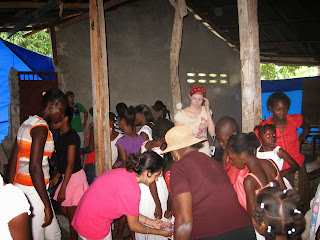 When I was in Haiti I sat in on a regional conference of educators, organized by the U.S. evangelical mission Haiti Partners. One by one the teachers introduced themselves, each of them including some iteration of the unusual phrase "I practice open space technology." My friends at HP, Kent Annan and John Engle, later described open space to me: it's a way of convening a meeting that begins with no agenda, only a theme and a facilitator who can organize settings. Participants nominate breakout sessions and then serve as hosts for those sessions; the facilitator sets a place and time for each session, and participants decide which sessions they want to make sure they participate in. Each session takes notes and reports back to the whole group the gist of what they discussed.
Open space meetings, when well run, are perhaps paradoxically highly disciplined and productive times. They are also highly democratic: anyone in the room can lead a breakout session, regardless of tenure or notoriety. People's passions are channeled into real outcomes, and meanwhile they are revitalized in their commitments to their colleagues and the convictions that brought them together in the first place. This, to me, sounds like the first-century gatherings of the fledgling church. It sounds like what the apostle Paul had in mind when he simultaneously held up order and chaos, control and creativity, as inherent to the church's mission.
When I was in Haiti I sat in on a regional conference of educators, organized by the U.S. evangelical mission Haiti Partners. One by one the teachers introduced themselves, each of them including some iteration of the unusual phrase "I practice open space technology." My friends at HP, Kent Annan and John Engle, later described open space to me: it's a way of convening a meeting that begins with no agenda, only a theme and a facilitator who can organize settings. Participants nominate breakout sessions and then serve as hosts for those sessions; the facilitator sets a place and time for each session, and participants decide which sessions they want to make sure they participate in. Each session takes notes and reports back to the whole group the gist of what they discussed.
Open space meetings, when well run, are perhaps paradoxically highly disciplined and productive times. They are also highly democratic: anyone in the room can lead a breakout session, regardless of tenure or notoriety. People's passions are channeled into real outcomes, and meanwhile they are revitalized in their commitments to their colleagues and the convictions that brought them together in the first place. This, to me, sounds like the first-century gatherings of the fledgling church. It sounds like what the apostle Paul had in mind when he simultaneously held up order and chaos, control and creativity, as inherent to the church's mission.

Monday, November 04, 2013
In Search of a Chaordic Conference: The Permanent Revolution Roadshow
I'm now mostly through The Permanent Revolution, the case for a rediscovered apostolic ministry from Alan Hirsch and Tim Catchim. I'm highlighting a lot; it's a rich and energizing book, one that I'll return to a fair bit. It's evidence of Hirsch and Catchim's particular genius that they've read as much as they have, let alone that they've so effectively synthesized it for the church. I have, for example, roughly outlined two followup books from Hirsch, whenever he's ready.
 The thing that's in my head right now is the notion of chaordic ecclesiology--the notion that a church should be equal parts chaos and order. Hirsch and Catchim appropriate the term chaordic from Dee Hock, founder of Visa and author of The Birth of the Chaordic Age. A chaordic organization "has a deeply held purpose and set of principles at the very center . . . and yet also has high creativity at the edges." As Hock puts it,

To the degree you hold purpose and principles in common among you, you can dispense with command and control. People will know how to behave in accordance with them, and they'll do it in thousands of unimaginable, creative ways. The organization will become a vital, living set of beliefs.I don't suppose anyone reads that and pictures a church. I certainly don't, which is one of the problems Hirsch and Catchim identify in the contemporary Western church. Not enough chaos, mainly, and yet also not enough order: local churches and global denominations alike are bound more by cultural commonalities and external commitments (such as statements of faith, catechisms and other organizing documents) than they are by a unified and internalized vision. Chaos and the creative process that resembles it are viewed with suspicion; meanwhile bureaucratic checks and balances replace the internal logic of a well-ordered system. Don't believe me? Among other characteristics of a chaordic church (which, Hirsch and Catchim suggest, would characterize the church of the first century, as well as the contemporary secret church in China) are the following, all of which eschew bureaucracy and invite creative chaos, none of which are visible in most Western expressions of Christianity:
* Are self-organizing and self-governing in whole and in part * Are powered from the periphery and unified from the core * Are durable in purpose and principle and malleable in form and function * Learn, adapt and innovate in ever-expanding cycles * Liberate and amplify ingenuity, initiative, and judgment * Equitably distribute power, rights, responsibility, and rewards * [Are] compatible with and foster diversity, complexity, and change * Constructively use and harmonize conflict and paradoxBottom line: the church, in its primal, chaordic state, was organized not as an institution or organization but as a movement. The contemporary Western church is not primal, nor chaordic, nor a movement. I think I would very much like a chaordic church. But I'm a realist: churches aren't changed by good ideas. They're changed by changing expectations. Churches change from the outside in. Youth group members grow up and return to church expecting loud music and chubby bunnies, and where they don't find them, they agitate for them. Enough pastors find enough interesting ideas in enough business books, and suddenly churches have org charts and executive pastors and mission statements and marketing budgets. Change in churches is like sleight of hand; it only works when people are looking somewhere they wouldn't otherwise look. A good liminal space for such subversion is the contemporary church conference. Most church conferences, of course, aren't especially subversive: they have their own form that they're accustomed to, and they follow it as slavishly and blindly as most of us follow the Kardashian family. So conferences sandwich a few innovative ideas in among lots of bangs and whistles and sounds and fury. You sing a little, you listen a lot, you spend a little money, you trade business cards, and you go home. It's a lot like church, actually. But a chaordic conference, now that would be interesting. I imagine a conference in which equal time is given to the celebration of order--those organizing purposes and principles that bind us together, some more consciously than others--and to the celebration of the often chaotic creative process. I go to a fair number of conferences, and I for one would like to not be a consumer of them so much as a participant in them. I'd like them to require creative collaboration from me and call on me to reaffirm who I am in community with everyone else present. I'd like to go to a conference expecting to be recentered, so that I go home with a renewed and even clearer sense of what motivates me in my mission, and to be stretched, so that I am more alert to the shortcomings in my local context that have perhaps been sanctified by the status quo. I'd like both these itches scratched, and yet when it's over I'd like them both to continue to itch. So, that's what I want. How to get it--ah, there's the rub. In my next post I'll explore some possibilities, based on best practices I've observed. Till then, though:
* What church-related conferences do you find most compelling, most resonant, most chaordic? * What makes them that way?
Thursday, October 31, 2013
This Is Who I Am: A Personality Profile Matrix
I thought it might be interesting to see all my various personality profiles mashed up together. So I went to tagxedo.com, which is one of those nifty wordcloud generators, and came up with a rough system for weighting the profiles:
* I typed in my top term from APEST and Enneagram five times.
* I typed in my second APEST category four times, then three, then two, then one, till all five were represented.
* I typed in my two Enneagram directions three times each.
* I typed in my Myers-Briggs and StrengthsFinder terms twice each.
* I typed in my Enneagram wing once.
Then the wordcloud generator did its funky work. Here is what it kicked out, designed as a footprint, which I think is a pretty good visual representation of how I fit into the world.
 Or, if you prefer, here I am as a trendy, self-aware giraffe:
 This is not at all scientific. It's just for fun. If you do something similar, let me know; I'd love to see how you look. If you're wondering what any of these words means, let me know and I'll fill you in.


Monday, October 21, 2013
Whistling--A Life Plan
My dad taught me to whistle. I've recently become aware of this. I don't think he taught me how to whistle; I would hope that I taught myself that, since the mechanics of whistling are simple: as Lauren Bacall put it, "You just put your lips together . . . and blow."
But the bliss of whistling -- that I learned from my dad. He whistles a lot. Like, all the time. And, like, everywhere. Walking through a store. Walking through the neighborhood. Stepping into the pews at church. Sitting down for dinner at home. He whistles while driving, while reading, while waiting around for the next thing to happen. He's a whistler. And so am I.
I started to become aware that I had inherited my dad's whistling disposition when I got the eponymous first album by "newgrass" band Nickel Creek. The trio that made up the band played their respective instruments with the speed of youth and the acumen of veterans. And I whistled right along with them. I whistled the melody; I whistled the harmony. I whistled the fiddle part; I whistled the mandolin part. And I did it all from the comfort of my desk at work.
Imagine how that must have annoyed my neighbors. I got made fun of a fair bit, and I know that I deserved it. I'm pretty confident, however, that as annoying as I was, no one stayed annoyed at me. Whistling is too innocent, too blissful, to resent for long. Plus, there's no denying I'm good at it. Anyway, I kept doing it --not out of conviction but out of habit.
Something happens to you, I think, when you make a habit of whistling. It lightens the load of life, I think. It's hard to nurse grudges while you're whistling. It's hard to dwell on some slight, to fret over some mistake. It's hard to stay angry or stay panicked. Whistling takes you out of time and drills you down deep into a particular moment. If you're whistling, chances are you're in the zone.
Or maybe you're desperately trying to get in the zone. "Whistling in the dark" is what we call putting on a brave face; ironically, it's roughly equivalent to keeping a stiff upper lip, a state that is hardly conducive to whistling. Whistling somehow, mystically, shores up our resolve, emboldens us in the face of danger. We distract ourselves by whistling in order to do what we might not otherwise want or feel able to do. If you find yourself whistling, chances are you're in the thick of it.
My dad taught me to whistle not out of fear but out of serenity. He didn't set out to do so; he just whistled everywhere he went, and he gave off a sense of serenity in the process. The message kind of stuck with me, and the habit embedded itself in me. And now, the older I get, the more I get it: life is no match for a person who whistles.
You think you're a good whistler? Put your lips together and blow through this one -- "The Lighthouse's Tale" by Nickel Creek.
Tuesday, October 15, 2013
Prophetiquette: How to Be a Prophet Without Being a Jerk
In my previous post, most excellent blogophile, I identified some pitfalls that people facilitating a paradigm shift often stumble into. As a reminder (although, come on, how long would it take you to read a 500-word post?), they were as follows:
1. Treating smart people like they're stupid.
2. Treating competent people like they're incompetent.
3. Treating committed people like they're uncommitted.
I suggested that these pitfalls could be avoided, or their impact mitigated, by a prior commitment to the second great commandment of Jesus: Love your neighbor as yourself.
 Today I read, in Alan Hirsch and Tim Catchim's energizing book The Permanent Revolution, a similar set of rules for people of a prophetic temperament. The authors are setting up a kind of taxonomy of spiritual "intelligences," the various aptitudes listed by the apostle Paul in Ephesians 4:1-16 that, taken together, are the engine of Christianity as a missionary movement through history: Apostles, Prophets, Evangelists, Shepherds (or pastors) and Teachers (APEST). Everyone, it seems, is bent toward one of these intelligences, something that appeals to the Myers-Briggs junkies among us. But the emphasis here is not on the individual but on the collective--how the five share their energies, pool their resources and engage in common mission. I'll concentrate here on prophetic intelligence, since it's related to paradigm shifting (and since that's as far as I've gotten in the book), but the greatest value in any one piece of the APEST puzzle is found in the context of the whole.
Anyway, Hirsch and Catchim define a prophet generally as a "guardian of faithfulness."
Today I read, in Alan Hirsch and Tim Catchim's energizing book The Permanent Revolution, a similar set of rules for people of a prophetic temperament. The authors are setting up a kind of taxonomy of spiritual "intelligences," the various aptitudes listed by the apostle Paul in Ephesians 4:1-16 that, taken together, are the engine of Christianity as a missionary movement through history: Apostles, Prophets, Evangelists, Shepherds (or pastors) and Teachers (APEST). Everyone, it seems, is bent toward one of these intelligences, something that appeals to the Myers-Briggs junkies among us. But the emphasis here is not on the individual but on the collective--how the five share their energies, pool their resources and engage in common mission. I'll concentrate here on prophetic intelligence, since it's related to paradigm shifting (and since that's as far as I've gotten in the book), but the greatest value in any one piece of the APEST puzzle is found in the context of the whole.
Anyway, Hirsch and Catchim define a prophet generally as a "guardian of faithfulness."

They are seen to be the God-intoxicated, biblical existentialists, calling all to live faithfully in covenant relationship with God and consistent with his kingdom and rule in the world. The effect of prophetic ministry is to bring our world into divine focus.This presumes, all too rightly, that most of us live out of sync with what we profess about God and the world, making the prophetic intelligence a somewhat maddening burden:
This experience of encountering two contradicting realities causes the prophet to passionately call into question the existing order of things. ... By forcing us to face up to these gaps in our faithfulness, the prophet creates a context that allows us to perceive the truth of our situation. ... People, and the institutions they inhabit, can find themselves being held hostage by their own logic and systems of justification. In such situations we need prophetic imagination to deconstruct and dismantle these systems of justification that so often conceal our fears and selfishness.Sound like a paradigm shift? It's a helpful reminder that paradigm shifts aren't just change for the alleviation of boredom; they're an acknowledgment, arrived at gradually by increasing numbers of people, that something is out of sync with reality, and a commitment, arrived at with varying levels of enthusiasm, to return to equilibrium. Paradigm shifts need prophets, not just to shake the foundations but to identify where the foundations are and how we find our way back to them. Given this setup, prophets sound awesome, right? But they have their own rules of engagement. Hirsch and Catchim identify six. 1. The prophet is to point people to God, not to the prophet's preferred reality. There's something objective driving the prophet's concern, which is why we test prophets to distinguish between something objective and something loudly, annoyingly subjective. 2. "Criticism is not a license for cynicism." Underlying the prophetic task is a commitment to the possibility of change and to the responsibility to point people toward that change--not just to chide people for their stasis. 3. Love is the foundation of prophetic ministry. If you're not motivated by love for the people you're prophesying to, you're doing it wrong. 4. "Critical distance should not translate into permanent distance." Prophetic imagination has its own allure, and can draw us into a bubble of our own insight. No man is an island, and no prophet is without a people. 5. "Prophets are not infallible." Prophets rely on intuition, which can be wrong. Prophets, again, need the rest of us to test and approve their prophetic imaginations, just as we need prophets to keep pushing our buttons. 6. Prophets can make a situation worse. Prophets have a responsibility to their own message, to keep refining it and asking questions of it and considering the pitfalls of it. There's nothing worse than a prophet who doesn't know what she's talking about. Anyway, that's how Hirsch and Catchim see it. It's a tragedy when prophets get stoned, or killed, or marginalized or suppressed. But sometimes, when they lose sight of these rules, a little suppression might be in order. Prophets aren't messiahs, after all. They work for us, just like we work for us.
Monday, October 07, 2013
Shifting Paradigms 101: Pre-Course Requirements
I run around with a lot of people who are trying to change people's minds on a lot of things. How we do church, how we do publishing, how we do social change, how we do what we do--all of these things are, in the minds of my friends (and, for the most part, in my mind as well), up for revision.
Some of these things are better primed for change than others. "There's something about the gallows," a publishing executive I know likes to say, "that focuses the mind." Publishing, in other words, is in danger of perishing--unless we make some changes. I think that's hyperbole, but I think that mainly because I'm predisposed to change and see it as the normal order of things.
In any case, a change junkie would say something like that, wouldn't they? "Don't waste a crisis," I think Rahm Emmanuel said when he stepped into the role of White House Chief of Staff for new president Barack Obama. "The sky is falling!" doesn't have to be cause for panic; shouted by the right Machiavellian mouth, it can be the preamble to a paradigm shift.
Many a movement has been dissembled from within, however--even by the loudest, shrewdest champions of it. I'm pretty sure that the following remedial rules apply to any effort to lead people through significant change:
 1. Don't treat smart people like they're stupid. You see the need for change sooooo clearly; your colleagues see things differently. Do them and yourself (and even your agenda) a favor and assume they have well-reasoned reasons for being dubious about your proposal.
2. Don't treat competent people like they're incompetent. You'll be tempted to point to failures under the current paradigm. Remember as you do that these failures trace back to real people, who acted in good faith on their best effort drawing on the best information they had available. Even if they acknowledge that the failure was in fact a failure (they may well disagree with you), it will still sting to hear it discussed, and they won't be especially excited to stick their neck out for something new.
3. Don't treat committed people like they're uncommitted. Just because you perceive that people's hard work is misdirected doesn't mean that they're not working hard, in good faith, toward a desired outcome that looks a lot like yours. Some of these folks will have been at it for years--years more than you have, actually. I've found this often to be the case that newcomers see the dead ends more quickly and clearly, but old-timers see the potholes and pitfalls, and they know from experience the damage they can do.
Pitfalls and potholes are, of course, common along the journey through a paradigm shift. Just because they're there, looming on the horizon, doesn't mean change isn't in order. You know that; the other early adopters know that. So do, as a matter of fact, the smart, competent, committed people you're trying to coax into the change you're seeking.
Paradigm shifts aren't the sort of thing you can manufacture or manipulate; they are a kind of collective epiphany that people arrive at in staggered sequence -- some subtly, some dramatically, some begrudgingly. Paradigm shifts don't need puppet masters, mercilessly pulling the strings of people they think are too stupid or lazy or unskilled to respond to reality. Paradigm shifts need something more like a midwife: knowledgeable about the signals for action, attentive to the vulnerabilities and anxieties that get exposed along the way, ready to respond to any crises that present themselves, committed both to the one to be born and the one giving birth.
Like everything, then, the first requirement of a change agent is love--not love for the idea of change or the imagined future some change may bring, but love for those among whom some change is being born. For some change agents, this kind of love may be its own paradigm shift.
I don't suppose I'm the only person who's thought about this, nor am I the only person who's struggled through needed change in an organization or two. So I hope you'll share your stories and insights about prerequisites for paradigm shifts, either here in the comments or on my Facebook page, Google Plus or Twitter.
1. Don't treat smart people like they're stupid. You see the need for change sooooo clearly; your colleagues see things differently. Do them and yourself (and even your agenda) a favor and assume they have well-reasoned reasons for being dubious about your proposal.
2. Don't treat competent people like they're incompetent. You'll be tempted to point to failures under the current paradigm. Remember as you do that these failures trace back to real people, who acted in good faith on their best effort drawing on the best information they had available. Even if they acknowledge that the failure was in fact a failure (they may well disagree with you), it will still sting to hear it discussed, and they won't be especially excited to stick their neck out for something new.
3. Don't treat committed people like they're uncommitted. Just because you perceive that people's hard work is misdirected doesn't mean that they're not working hard, in good faith, toward a desired outcome that looks a lot like yours. Some of these folks will have been at it for years--years more than you have, actually. I've found this often to be the case that newcomers see the dead ends more quickly and clearly, but old-timers see the potholes and pitfalls, and they know from experience the damage they can do.
Pitfalls and potholes are, of course, common along the journey through a paradigm shift. Just because they're there, looming on the horizon, doesn't mean change isn't in order. You know that; the other early adopters know that. So do, as a matter of fact, the smart, competent, committed people you're trying to coax into the change you're seeking.
Paradigm shifts aren't the sort of thing you can manufacture or manipulate; they are a kind of collective epiphany that people arrive at in staggered sequence -- some subtly, some dramatically, some begrudgingly. Paradigm shifts don't need puppet masters, mercilessly pulling the strings of people they think are too stupid or lazy or unskilled to respond to reality. Paradigm shifts need something more like a midwife: knowledgeable about the signals for action, attentive to the vulnerabilities and anxieties that get exposed along the way, ready to respond to any crises that present themselves, committed both to the one to be born and the one giving birth.
Like everything, then, the first requirement of a change agent is love--not love for the idea of change or the imagined future some change may bring, but love for those among whom some change is being born. For some change agents, this kind of love may be its own paradigm shift.
I don't suppose I'm the only person who's thought about this, nor am I the only person who's struggled through needed change in an organization or two. So I hope you'll share your stories and insights about prerequisites for paradigm shifts, either here in the comments or on my Facebook page, Google Plus or Twitter.

Wednesday, October 02, 2013
How Not to Pray
My church has found me. I must have passed some threshold of monthly giving or something, because lately everyone in every corner of the church is inviting me to serve with them. Youth ministry, homeless ministry, marriage ministry, small group ministry, communications, uh, ministry, and even . . . prayer ministry.
Yes. I, who scored "present" on an online test measuring the quality of my faith, hope and love, am now regularly praying for people after our worship services. Don't worry, I don't get a lot of traffic. But occasionally someone comes up to me for prayer, at which point I am, occasionally, sent into a tizzy.
Recently I was sitting around, trying to look welcoming and spiritual, trying not to look at my phone, when I was approached by a woman I'll call Joan. Joan needed prayer, mainly for discernment, because she had two friends who she was trying to figure out when and how to inform that they were sinners and she would no longer be hanging out with them.
Seriously. This is the sort of thing some people request prayer for. This is, I believe, how not to pray.
I listened to her story and tried to remain sympathetic, but inside I was sort of seething. Who does this woman think she is? I wondered. In what universe would this kind of prayer make sense? What kind of God would respond well to a prayer like that? I asked her some questions for clarification, and then I closed my eyes and started preaching.
This, by the way, is also how not to pray. I learned this from Andrew Wheeler, in his excellent and woefully underappreciated book Together in Prayer. Preaching with your eyes closed is not praying. When you tell God what you want other people in the room to know--when you teach God Christian doctrine or remind God how bad people are at following him--you're not praying. You're preaching, and you're not even dignifying your audience by looking them in the eye.
 I know this. I get really testy whenever I am invited into prayer, and I close my eyes, and someone does this. I gripe about it in the car to my wife on the way home from such proto-prayer times. I'm hip to the fact that this is not how to pray. And yet I did it. I think it's fair to say they set the bar pretty low for prayer team at my church.
Most of us are unaware of when we're preaching with our eyes closed. And in fairness to us, it's an easy habit to slip into. God is invisible, ineffable; God may be present, but he's not in view. In the meantime, there's any number of visible, effable people standing right in front of us, and we're pretty sure they need to hear what we need to say. It's instinct, the way any will to power is an instinct.
Anyway, I "prayed" for this woman, thanking God for placing her in proximity to these two friends, praising God for being loving and merciful and patient and grace-giving and for loving even those who reject him. I asked God to help her sort out when to speak words of challenge to them, but mainly I invited God to show his love for these two people through this woman. I laid it on thick, I can tell you.
I opened my eyes and she was still there, so I asked her what she was thinking. She softened a bit, talking about her concern for her own children, who were learning some bad habits from one of these people. She talked also about her concern for the children of the other person, who were suffering from the mistakes their mom was making. She lamented how many people call themselves Christian and yet ignore obvious ways that Christ might speak into their relationships, their morals, their life decisions.
I softened too, considering how hard it must be for a parent to make decisions not just for herself but for her kids, how desperate in particular Christian parents must be to see their kids embrace faith in the way they've embraced it, and how scared they must be given the increasing cultural disaffection with a Christian subculture. So we closed our eyes again, and this time I tried to keep it prayerful. I again prayed for love and grace and mercy, but I also prayed for courage and opportunity to speak truth and all that stuff. When we were done, I opened my eyes again. So did she.
Then she complained about how this generation has rejected good family values, and how the previous generation was all great and awesome. I hate that stuff. I prodded her a bit on it, and to her credit, she gave in a bit. Then we shook hands and parted ways.
Ta da! I had prayed for someone. Mission accomplished. Box checked.
This coming Sunday I'm all in: I watch that Bible TV show with some homeless folks, then I talk about following Jesus with a bunch of middle schoolers, then I attend the worship service, then I pray again. And a few hours after that I discuss a book over snacks with my small group. I may even edit a church newsletter or something. I'll feel pretty good about myself, I suspect--good enough that I'll be tempted to preach at someone with my eyes closed. Maybe you could pray for me that I won't do that. I'd go so far as to say that something like that is how we should pray, and I'd welcome it.
I know this. I get really testy whenever I am invited into prayer, and I close my eyes, and someone does this. I gripe about it in the car to my wife on the way home from such proto-prayer times. I'm hip to the fact that this is not how to pray. And yet I did it. I think it's fair to say they set the bar pretty low for prayer team at my church.
Most of us are unaware of when we're preaching with our eyes closed. And in fairness to us, it's an easy habit to slip into. God is invisible, ineffable; God may be present, but he's not in view. In the meantime, there's any number of visible, effable people standing right in front of us, and we're pretty sure they need to hear what we need to say. It's instinct, the way any will to power is an instinct.
Anyway, I "prayed" for this woman, thanking God for placing her in proximity to these two friends, praising God for being loving and merciful and patient and grace-giving and for loving even those who reject him. I asked God to help her sort out when to speak words of challenge to them, but mainly I invited God to show his love for these two people through this woman. I laid it on thick, I can tell you.
I opened my eyes and she was still there, so I asked her what she was thinking. She softened a bit, talking about her concern for her own children, who were learning some bad habits from one of these people. She talked also about her concern for the children of the other person, who were suffering from the mistakes their mom was making. She lamented how many people call themselves Christian and yet ignore obvious ways that Christ might speak into their relationships, their morals, their life decisions.
I softened too, considering how hard it must be for a parent to make decisions not just for herself but for her kids, how desperate in particular Christian parents must be to see their kids embrace faith in the way they've embraced it, and how scared they must be given the increasing cultural disaffection with a Christian subculture. So we closed our eyes again, and this time I tried to keep it prayerful. I again prayed for love and grace and mercy, but I also prayed for courage and opportunity to speak truth and all that stuff. When we were done, I opened my eyes again. So did she.
Then she complained about how this generation has rejected good family values, and how the previous generation was all great and awesome. I hate that stuff. I prodded her a bit on it, and to her credit, she gave in a bit. Then we shook hands and parted ways.
Ta da! I had prayed for someone. Mission accomplished. Box checked.
This coming Sunday I'm all in: I watch that Bible TV show with some homeless folks, then I talk about following Jesus with a bunch of middle schoolers, then I attend the worship service, then I pray again. And a few hours after that I discuss a book over snacks with my small group. I may even edit a church newsletter or something. I'll feel pretty good about myself, I suspect--good enough that I'll be tempted to preach at someone with my eyes closed. Maybe you could pray for me that I won't do that. I'd go so far as to say that something like that is how we should pray, and I'd welcome it.

Subscribe to:
Posts (Atom)
Both Inspiration and Cautionary Tale: Excerpts from Middling
What follows is an excerpt from the Winter 2021 edition of Middling, my quarterly newsletter on music, books, work, and getting older. I...
-
 In a previous post I recounted the eight priorities of making a scene, according to Talking Heads frontman David Byrne in his recent book H...
 -
 OK, I'll admit it: I've become a semiregular viewer of Joel Osteen (of the clan Osteen!). He's on TV every Sunday right after Th...