Monday, March 07, 2016

Keep Easter Weird

There's a conspiracy afoot, people. It extends to the highest offices in the world: the British government, the Archbishop of Canterbury, the Pope, the Orthodox primates—"and," undoubtedly, in the words of the great film So I Married an Axe Murderer, "Colonel Sanders before he went teats up."

The conspiracy is to set a permanent, fixed date for Easter.

We simply can't let that happen.

"For one and a half millennia," writes Nick Miller of the Sydney Morning Herald, "for Anglicans and Catholics, Easter Sunday has been the first Sunday after the first full moon following the spring equinox – a convoluted formula which means the date can vary by more than a month from year to year."

This is the problem as leaders of Catholic, Anglican, and Orthodox churches see it: Easter is too wild, too unpredictable. You have to work too hard to let people know it's happening. Schools have to excuse too many unscheduled absences. Stores have to concoct too many algorithms to schedule their sales. Such chaos is beneath a society as well-heeled and commercialized as ours. Thus say our religious authorities and corporate overlords. I imagine some cabal of evangelicalati is giving their nod to it as well: Rick Warren, John Piper, and whoever else everyone seems to think speaks for me.

But I'd like to nip this thing in the bud. It's a good thing that Easter is hard to schedule. We are blessed by the confounding of our calendars represented in Easter. It makes us harder to subjugate. It provides the last line of resistance against the commercializing forces of modern materialism. Keeping Easter a moveable feast keeps Christians on our toes. It keeps Christianity untamed.

TWEET THIS: Keeping Easter a moveable feast keeps Christians on our toes. It keeps Christianity untamed.

As I learned from Michelle Van Loon, whose book Moments and Days explores the Jewish feasts and Christian calendar and will release this fall (just in time for Advent!), the lunar calendar informs the Jewish feasts, and those feasts inform the Christian holy days that followed them. Easter is tagged to Passover because Jesus was commemorating Passover when he was arrested, and Passover is celebrated in accordance with the cycles of the moon. The birth of the church takes place on Pentecost, a Jewish feast that is similarly rooted in the agricultural year, tied as it is to the lunar calendar. These celebrations were born in a time when empires had yet to colonize time itself: that would come a few centuries later, when holy Roman emperors deemed it expeditious to bind time to the sun rather than the moon, the better to systematize their empires with.

Holidays tied to the lunar calendar are more organic than those tied to the solar year. They remind us that calendars are social constructs. They force us to pause and think about when, and why, we celebrate and commemorate. They reassert that there are rhythms more natural than the ones we have acquiesced to, that our sacred celebrations transcend communal or corporate convenience. Our holidays should be weird because, as the apostle Peter tells us, we are a "peculiar people" (1 Peter 2:9, KJV)

TWEET THIS: Our holidays should be weird because, as the apostle Peter tells us, we are a peculiar people.

I'm not calling for anything radical here. I'm not saying we should dress funny for Easter (although, frankly, some of you do). I'm not demanding that Christmas be untethered from December 25 (although has celebrating Christmas every December 25 really helped keep Christ in Christmas?) any more than I'm demanding that civil holidays like Independence Day no longer be fixed to particular days, like July 4. (I think if you're going to blow up a bunch of stuff one day every year, you should keep it as predictable as possible.) I'm simply suggesting we leave well enough alone, that we keep Easter weird. It's one of the cooler things about us, I think.

TWEET THIS: Keep Easter weird. It's one of the cooler things about us.

Monday, February 22, 2016

The Fight or Flight of the Bumblebees

When I was very nearly five years old, my brother and I would regularly cross the street to play with our neighbor Jimmy. On one such occasion, we were running around the house over and over again (like you do) when we stumbled into a swarm of bees. My brother and Jimmy, being several months older than I, knew to stand still; the bees were as scared of us as we were of them, and they would not attack if not provoked. I, young and stupid, had not learned that lesson. I writhed in panic as one bee made a literal beeline for my nose. Once I felt the beat of its wings on my face, I turned and ran, making a metaphorical beeline for the street, where I was promptly hit by a car.

I broke six ribs that day. Bee stings suck, but they don't suck that much.

I have, ever since, had an irrational panic associated with flying, stinging insects. I don't run into the street any more, but neither am I particularly good at feigning calm around them. Like nothing else, bees stir up in me the fight or flight response.

Fear, I understand, is a natural, biochemical thing. Fear is what we experience when we are confronted with danger. Fear attends to every risky endeavor because that's what fear is supposed to do: to remind us of risk, to prepare us for danger.

It's what we do with our fear that gets us into trouble. We fight, with the adrenaline-crazed passion of a mother bear or a wounded wolf. Or we take flight, our mind so set on the object of our fear that we fail to notice the other hazards in our path. It takes a lot of discipline to address our fear effectively, to fight fair or to fly in the right direction.

TWEET THIS: It takes a lot of discipline to address our fear effectively, to fight fair or to fly in the right direction.

A measured response to our fear, in fact, may lead us to discover that we're fighting or fleeing the wrong thing—our spouse instead of our boss, perhaps, or the wee little bee rather than the two tons of steel barreling down the street. We may even realize that we've mistaken fear for something else: anxiety, worry, insecurity, bigotry. In the face of some fear, the best response may not be to fight or flee, but to listen, to question, to nonviolently resist, to confront, to repent, to love.

We may find ourselves facing opponents or adversaries, but in most cases, our true enemy, our only enemy, the one who can cause us and those around us the most harm, is fear. We need to confront the fear before we address the thing we find ourselves fearing. We'll often see opportunity where we had formerly seen a threat - or, in the place of an enemy, a friend, or a neighbor, or a person created in the image of God - once we cast the fear out.

Monday, February 08, 2016

Everybody Knows Your Name: Two Recent Books on Shame

When someone mails you a book about shame, you get to thinking. When two someones send you two different books on shame, you get a little self-conscious. When one of those two someones sends you two copies of the same book on shame, maybe God is trying to tell you something.

(When that book is explicitly directed toward women and you're a man, you get to thinking all over again.)

In my defense, there's a reason I was sent The Soul of Shame by Curt Thompson and Overcomer: Breaking Down the Walls of Shame and Rebuilding Your Soul by Aubrey Sampson. As a book editor, I had made bids to publish both of them when they were still just proposals--each a gestating idea in the mind of the author. Aubrey's book went to a different publisher; I managed to sign a contract with Curt, but I went to a different publisher before he finished writing. So while I was familiar with both projects, each when finished was a new book to me, a printed and bound truth bomb right there on my doorstep.

As I read and reflected on both these books I kept thinking about a song by Mavis Staples, recorded with Jeff Tweedy of Wilco. If, as both Curt and Aubrey suggest, shame is countered by encounter - if we are best equipped to contend with shame when we understand it as a common enemy that has power over each of us but not over all of us - then "You're Not Alone" isn't just good news; it's gospel.

When I was a kid we sang shame onto each other: "Shame, shame, everybody knows your name." But also, when I was a kid, the notion of everybody knowing our name was a source of encouragement - a universal desire that directed our steps. "Sometimes you want to go," the theme song to the TV show Cheers declared, "where everybody knows your name." (My friends Lance Ford and Brad Brisco reflect on that anthem in their forthcoming book Next Door As It Is in Heaven.) The cure for shame, it turns out, closely resembles the poison. We fear being found out, being known for what we've done, and what we've failed to do. But the gospel, alluded to by Mavis, celebrated by Curt and Aubrey (and Lance and Brad), is the good news that a God who knows us inside and out has taken all our shame upon himself, and has written our name in the book of life. We will never be forgotten; we will never be alone. We will know fully, even as we are fully known.

Monday, February 01, 2016

The Cult of the Big C

You know what bugs me? "The big C church." I hear pastors and church leaders and culture leaders associated with Christianity say it all the time. And all the time, it drives me crazy.

When these leaders refer to the "big C Church," they're referring not to their own, local gathering of Christians, but to the aggregation of every Christian gathering throughout the world, a head count of every Christian in the history of the world. It's a heady, heady concept. But then you look at the marquis at the entrance of their church building, and you look at the masthead of their church bulletin, and what do you see? A big C.

It's appropriate to capitalize the C on a church's marquis or masthead, though. That's what you do with proper nouns—from institutional names to honorific titles. To lowercase the name of your church would be an act of shocking pretension. If you're not the first church of e. e. cummings or bell hooks baptist, then it would be silly to act like it.

The flip side of the rules of capitalization is that you don't capitalize things that are functional, or conceptual, or generic, or of ambiguous relation. President Obama (honorific) is president (functional) of the United States. The church (generic) down the street is First Church of _________ (the institution).

TWEET THIS: The church (generic) down the street is First Church of _________ (the institution).

I get why people refer to the "big C church." Sometimes you need to speak universally of not just the church in your midst but the "great cloud of witnesses" that the New Testament names as the church in the world. Sometimes you need to identify yourself with fellow Christians on the other side of the world. It's a good, well-meaning impulse.

TWEET THIS: When we capitalize church we emphasize the institutionality of it.

But the nature of capitalization is to assign importance. When we capitalize "church" we emphasize the institutionality of it: We assert the "big C church" as something that everyone everywhere must take seriously, even show due deference to. It becomes equivalent in its meaning in the world to other such audacious entities: the United Nations (which is something more than a mere gathering of united nations), the Illuminati, the Mafia, Monsanto, that sort of thing. Such entities assert themselves into the world, flexing their muscles and declaring themselves as the world's great hope.

The church, as the living and active presence of Christ in the world, loses some of its vitality when it is so institutionalized. We aren't meant to be set on a pedestal or a throne; we are meant to sink into the dirt of our context, like a seed, there to die in order to bring about new life.

TWEET THIS: The church writ large is actually a small c church.

In this respect, the church writ large is actually a "small c church." Our activity in the world is subtle and silent, even as its impact is clearly felt: We are compared in the Scriptures to yeast in the dough, salt in the meat, light on a hill. It's not the church that is to be noticed, but what is made possible, visible, by the church. We must decrease; only Christ must increase.

TWEET THIS: We must decrease; only Christ must increase.

I don't expect anyone is going to join me on this bandwagon. The greatest hurdle is probably because I don't have a clever monicker for what I mean to compete with the cutesy "big C church." Everybody knows what people mean when they say that. Maybe it's evidence that we talk too much about the church to begin with, when we ought to just get to it and do it.

Maybe a hashtag would do it: #lowercaseus. We could make bumper stickers.

Monday, January 25, 2016

Hold On: Songs of Hope on Shuffle

I'm horribly antisocial on airplanes. I put earbuds in my ears before I buckle my seatbelt. Then I plug those earbuds into my iPhone, and for the duration of the flight I do essentially nothing but listen to my music.

"My music" is, of course, a misnomer. I didn't make it; I only bought it. But I do identify with it, and strongly so.

On my most recent flight I found myself putting down my Kindle, closing my eyes, and resting in Shawn Colvin's cover of Paul Simon's "American Tune."

But it's all right, it's all right,
Just weary to my bones.
Still, you don't expect to be bright and bon vivant
So far away from home.
And I don't know a soul who's not been battered ...

I had to actively suppress the urge to sing along, which is worse airplane behavior than actively ignoring your seatmates.

As the flight continued, I began to notice a recurring theme in the songs that tend to move me the most, a theme that responds to the lament in "American Tune." Here and there throughout my playlist is a plea, turning up somewhere in the lyrics, echoing either explicitly or indirectly the cry of yet another Shawn Colvin cover (this one from Tom Waits):

Babe, you've got to hold on.
Take my hand, I'm standing right here.
You got to hold on.

She sings that phrase dozens on times in one song. It's even the song's title. But as she sings it, she joins a chorus.

There's Regina Spektor: "Hold on—this is why we fight!"

There's David Bowie at his most compassionate—"Give me your hand! You're not alone!"—and at his most resigned: "If you think you're gonna make it, you better hang on to yourself."

There's REM encouraging me to "hold on," reminding me that "everybody hurts."

There's Colbie Caillet asking me to "take time to realize that I am by your side."

There's U2 inviting us to "take my hand—you know I'll be there if you can." Thirty years later they're looking for someone to return the favor in their song "Iris (Hold Me Close)."

And on and on. Other songs and themes move me as well, of course, but I'm struck by how recurrent this theme has become for me. I certainly know enough people—far too many people, in fact—for whom "hold on" has at times seemed the only encouragement left to offer. I certainly can recall my own moments where something as simple as holding on, to a friend or to God or to a dream or even merely to myself, has felt like an enormous leap of faith. I certainly observe, when I look around, a world full of people who seem to be barely hanging on, harassed and helpless, as the Good Book says, like sheep without a shepherd, for whom holding on is the only message that makes sense.

TWEET THIS: Songwriters plant themselves closer to desperation and world weariness than most of us.

I guess I'm not surprised this theme turns up so much. I think songwriters plant themselves much closer to the convergence of desperation and world weariness than most of us. The dream itself demands it: you don't flourish as a musician, a poet, without long stretches along the way in the hard country. Every feast carries memory of some famine. They see it, and they experience it, and they give voice to it. And we're reminded of our own need to hold on to something, to hold on for dear life.

An uncle of mine once told me that people who need crutches will find them. He was referring to my recent spiritual awakening, in my view, or opium-addiction, in his. I suppose he's right: We look for ways to prop ourselves up when we perceive that we can't stand on our own. But I find it hard to look down on people who are trying to hold on when they feel like everything is slipping away from them. And I find it encouraging that people who go looking for a hand to hold so often find it.

TWEET THIS: We look for ways to prop ourselves up when we perceive that we can't stand on our own.

U2's plea to "take my hand" comes from their song "Drowning Man," a riff on a scene from the Gospels where Peter attempts to walk on water and ends up needing Jesus to pull him back to the surface. It ends with the words of the prophet Isaiah:

Rise up with wings like eagles.
You'll run and not grow weary.

Behind the soundtrack to this universal longing is, I think, a universal conviction (however unconscious): However bleak the world becomes, there is a God who doesn't mind being a crutch, a prop. This God extends his hand to us, and transforms our desperate striving, our world-weary resignations, into free flight.
Friday, January 08, 2016

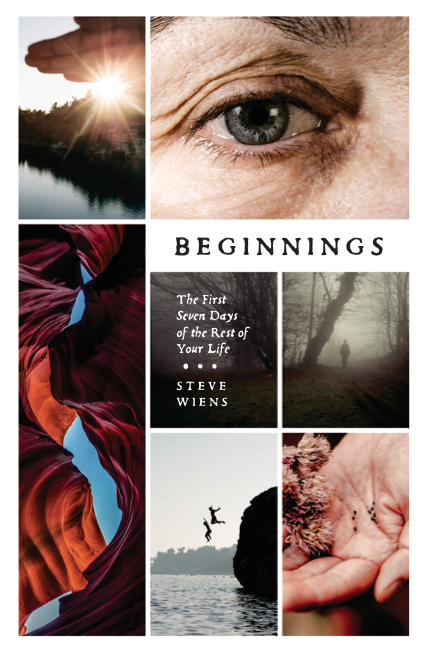
Stitched into Every Ending: A Guest Post from Steve Wiens, Author of Beginnings

I have had the great pleasure of editing a great number of great books. The most recent to be numbered among them is Beginnings: The First Seven Days of the Rest of Your Life, by Steve Wiens. I wanted to edit this book - I wanted to real bad. I wanted to so bad that I changed jobs and moved a whole time zone away from my home of twenty-two years to do so.

Not really. I mean, it's a great book and all, but come on.

But seriously, Steve's book was on the table when I started feeling the urge to take a new leap into a new void, to leave a job I'd enjoyed for nearly two decades and relocate from a place my wife had never not called home. I had gotten a taste of Beginnings as a proposal at my Illinois job, but I learned that Steve had signed with NavPress, a publisher in Colorado that happened to be in need of an editor. The fact that Steve's book was here, waiting for me, was reassuring: There are good books to be edited, good authors to befriend, even up in the high hills of Colorado. We would be moving, of course, and we would be leaving many significant relationships and sacred ties behind. We would be entering into an ending. But as Steve notes below, stitched into every ending is a beginning. And hovering over every beginning is the Spirit of the Living God, making flesh with a word and new life with a breath.

TWEET THIS: Stitched into every ending is a beginning. And hovering over every beginning is the Spirit of the Living God.

Here's Steve, reflecting on the genesis of his book about Genesis. Keep reading for a taste of the book itself. Trust me: It's delicious.

***

I suppose it might be considered a cliché to say that my first book discovered me; that it fluttered down to me in a bright burst of color and flame, beckoning and irresistible. But it did.

It came to me as a question, but one with a smirk and a wink. It was a delicious question, the kind that invites you to leave Bag End with only a walking stick and a stomach hungry for adventure.

I was stuck, but I was only beginning to realize it, and it was a sickening kind of feeling when I finally did. My life seemed to be drifting away from me, like someone was using a pair of bellows all wrong, extracting breath from me instead of adding it.

The question thundered around me, accompanied by random flashes of lightning, and I was dazzled enough to turn aside to see what it was before it rolled by.

What if the creative act of God described so richly in the Genesis poem was not simply an event in time, but a process that is reflected in all beginnings that follow?

What if new beginnings were lurking around every corner, inside every whisper, and even stitched into every ending? What if they hovered above us, and filled in the fault lines beneath us? What if being stuck wasn’t the inevitable destination?

What if the world, right here and now, is crying out once again, and what if the God who hears is responding, and sending, and moving, and acting?

So I wrote and wrote and wrote, and with three boys under the age of six, it was mostly done by magic tricks and stopping time. The more I wrote, the more I believed. It came in torrents, flooding me, until it didn’t. Then it trickled in: a paragraph, a sentence, a word. But it came all the way out, and I’m about to let it go into the world.

Beginnings is my manifesto of hope, that the creative activity of God is not finished, not even close. Beginnings is my defiant shout that even when we are lost in the inky blackness, there can emerge out of that swampland something glorious, something eternal, something covered in the goodness of God.

TWEET THIS: The creative activity of God is not finished, not even close. Steve Wiens

What follows are the first words I used to translate the fluttering reality in which I now am grounded. I hope it leaves you hungry for more.

THE ACHE HAD probably been creeping up on me, but I didn’t notice it until that night, sitting on the deck behind my suburban house looking out onto my suburban life. Isaac was two, and the twins were six months old. I was a pastor at a large church, I had been married for fourteen years, and my twenty-year high school reunion had come and gone.

I didn’t go to that reunion. I didn’t have the energy for the awkwardness, the sizing up, and the plastic cups of stale beer to chase down our stale memories.

But the ache that had been whispering through my body rattled to a clumsy stop on that night, in those suburbs, on that deck.

I had been looking at pictures of my friends who went to the reunion: my old girlfriend, the guys I used to go all night skiing with on those blisteringly cold nights in Minnesota, my soccer team. And I remembered all the beginnings.

I remembered moving from Southern California to Belgium the summer before seventh grade. I remembered the sour, un-American body odor of the team of men who moved our old furniture into our new house. That smell was the baptism of our new life in Europe.

I remembered my friend Colin who lived across the street in a two-story white brick house in Waterloo with black shutters, like they all were. I remembered the in-ground trampoline in his back yard, on which we spent hours and hours, jumping our way into adolescence. I remembered his mother’s unbearably loud voice, as it boomed around their house like a grenade and made us run for cover.

I remembered falling treacherously in love with Tammi the moment I saw her, coming down those stairs in the fall of my ninth grade year. She liked me back, and then she didn’t like me. I was devastated. That’s when I started listening to the Cure and Depeche Mode, bands who were created for teenagers like me who don’t know how to express the frightening chaos brewing beneath our skin, bubbling and boiling.

I remembered Mr. Tobin, my tenth grade English teacher. Every student should have a Mr. Tobin. He got to know each of us and selected books based on what he thought we’d like. The first book he gave me was Trinity, by Leon Uris. I remember staying up late into the night reading about Conor Larkin, the main character, who was everything I wanted to be but feared I wasn’t: brave and passionate and rough edged. Almost thirty years have passed since I met Mr. Tobin, and I credit my deep love for reading to his deep love for teaching.

I remembered kissing Angie under a starry summer night on that dock that jutted out into Lake Como, the thrill of that moment reflecting off the lake and making everything luminous that summer before our senior year. I can still see the picture of us at the homecoming game: she was beautiful, holding my hand under the dark October sky. I had a ridiculous acid-washed denim jacket on, with only the bottom button fastened in the chilly air. There was a grin on my face and my eyes were sparkling. I was seventeen.

I remembered driving around in Matt’s Bronco for hours, finishing off the beer that Carl’s older brother bought us. We must have burned hundreds of gallons of gas on those cold winter nights; we were irresponsible, irrepressible and immortal.

I remembered deciding to go to college in a sleepy little town in southern Minnesota, instead of up north, where most of my closest friends from high school had chosen to go. I remembered trying to explain it to them, in the awkward way that high school guys do. I don’t remember much of that summer before college. I only remember the familiar sensation that comes with every new beginning: the thrill of reinventing yourself running parallel with the fear of the unknown—the twin tracks that lead to everything else.

But on that night, on that deck, in those suburbs, the continual forward movement seemed to have stopped. The tracks had run out. I used to be in motion, rattling forward toward a destination that kept morphing. But on that stationary deck, I had become solid and stable, and stuck.

There would be no new beginnings.

My life should have felt full and rich, but instead it felt empty and dark. There was only the slow work of playing out the reality of the decisions that had already come and gone. I was a pastor. I was a father. I was a husband. I didn’t regret any of those things. I loved my kids and my wife and my job. But the finality of it all was a relentless crashing—wave after wave, under those stars, in those suburbs, on that night. It felt vacant, like staring into nothingness.

It was empty and full at the same time. Empty of beginnings, full of endings.

As I sat there motionless with the emptiness closing in around me, there was something else hovering above me in the darkness, but I couldn’t see it.

If I could have seen it, it would have looked like a beginning.”

* * *

Steve Wiens lives near Minneapolis, Minnesota, with his wife Mary and their three young boys. Steve blogs publishes a weekly podcast called This Good Word. You can order his book Beginnings here: Amazon | Books-A-Million | IndieBound | Barnes and Noble.

You know you want it.

Friday, December 25, 2015

The Leftover Shepherd

And there were shepherds living out in the fields nearby, keeping watch over their flocks at night. An angel of the Lord appeared to them, and the glory of the Lord shone around them, and they were terrified. But the angel said to them, “Do not be afraid. I bring you good news that will cause great joy for all the people. Today in the town of David a Savior has been born to you; he is the Messiah, the Lord. This will be a sign to you: You will find a baby wrapped in cloths and lying in a manger.”

Suddenly a great company of the heavenly host appeared with the angel, praising God and saying,

“Glory to God in the highest heaven,
and on earth peace to those on whom his favor rests.”

When the angels had left them and gone into heaven, the shepherds said to one another, “Let’s go to Bethlehem and see this thing that has happened, which the Lord has told us about.”

So they hurried off.
What if one stayed? After all, what kind of shepherds would they be if they left their flocks untended in the middle of the night? Not good shepherds, that's for dang sure. Good shepherds stay. Didn't David, the future king of the Jews, get left behind to tend the sheep when good news came to town?

So here's what I'm thinking: X - 1 shepherds ran off, in the wake of the heavenly host, to welcome the Son of God to the world. One shepherd stuck around. What must he have been thinking?

He was probably the youngest, the shepherd of no account. He probably knew that to be the case, as much because the other shepherds would regularly remind him as because the culture of the day was accustomed to pecking orders. There would have been no question of who got stuck with the sheep while the others got face time with Messiah.

That doesn't mean that this good shepherd of no account resented his position or his fellow shepherds or even the heavenly host that left him with the work of multiple men. It does mean he made a sacrifice of himself, missing out on the big good news in order to do his little good work.

I imagine that one of the host of angels stayed behind too. Because angels are a little like shepherds, if you think about it. But there's more: Here, on this lonely field at night, far removed from the shaking of history somewhere in Bethlehem - here was something worth seeing. To tend the sheep so that others may fall at the feet of the God of all mercy is a sacrifice of the highest order, the kind of thing that angels long to look on.

I imagine that lone shepherd, left alone by his friends in the stark silence of a holy night, might actually, finally, feel seen by the God who sees.

Tuesday, December 15, 2015

You're Welcome, Internet: Ten Years of Loud Time

Today marks my tenth anniversary posting to this blog. I haven't gone to great lengths to publicize it or promote it; I've just posted here and there and shared the links through whatever means were available to me at the time. In the beginning I didn't have Facebook or Twitter or any social media presence, apart from my work blog. Now I don't have a work blog, and in fact blogs may well have run their course. I, of course, blog on, undeterred.

I may, over the course of the next year, repost some of my favorites from the past decade, and when I do you may assume that I've been too lazy to write something new. In any case, I've enjoyed keeping this log of my interactions with books, films, music, and people for ten years. If you've read any of my nearly eight hundred posts, then thanks; if you've commented, God bless you. If you've shared my posts with other people, is there anything I can do for you?

Here's the text of my first post. Enjoy!

***

Long Overdue

It's about time I blogged privately. I've been designated blogger for InterVarsity Press, where I work as an editor, for three years now: I post to Strangely Dim weekly. But I've been wanting to do my own thing, unconstrained by the needs of the press. So here I go.

I've liked the idea of Loud Time for a Long Time. I come from a subculture that puts a lot of emphasis on the Quiet Time as the critical ingredient for spiritual growth. That's all well and good, except that you can only effectively be quiet in isolation, and while occasional isolation is a good thing, most of life is lived in real time with real people.

Enter Loud Time! In this blog I'll blather away about virtually anything, but my chief aim is to borrow wisdom from others and extend both the range and the depth of my relationships. If Loud Time is anything, it is a conviction that God abides with us even when we are not alone--which is perhaps a novel concept--and even when we are not quiet--which is perhaps a controversial subject. We grow together, which to my mind is how God intended it.

Thursday, December 03, 2015

A Lament for Eric Garner

A year ago today, a grand jury declined to indict a police officer for his role in the death of Eric Garner in New York. In his book Prophetic Lament, theologian Soong-Chan Rah wrote a prayer-poem, inspired by Lamentations 5, on behalf of Garner and Michael Brown and suffering black communities throughout the United States. It's excerpted here.

Remember, Lord, what happened
to Michael Brown and Eric Garner;
look, and see the disgraceful way they treated their bodies.
Our inheritance of the image of God in every human being
has been co-opted and denied by others.
The children of Eric Garner have become fatherless,
widowed mothers grieve their dead children.
We must scrap for our basic human rights;
our freedom and our liberty has a great price.
Corrupt officers and officials pursue us and are at our heels;
we are weary and find no rest.
We submitted to uncaring government agencies
and to big business
to get enough bread.
Our ancestors sinned the great sin of instituting slavery;
they are no more - but we bear their shame.
The system of slavery and institutionalized racism
ruled over us,
and there is no one to free us from their hands.
We get our bread at the risk of our lives
because of the guns on the streets.
Michael Brown's skin is hot as an oven
as his body lay out in the blazing sun.
Women have been violated throughout our nation's history;
black women raped by white slave owners on the plantations.
Noble black men have been hung, lynched and gunned down;
elders and spokesmen are shown no respect.
Young men can't find work because of unjustly applied laws;
boys stagger under the expectation that their lives
are destined for jail. . . .
Woe to us, for we have sinned!

Taken from Prophetic Lament by Soong-Chan Rah. Copyright (c) 2015 by Soong-Chan Rah. Used by permission of InterVarsity Press, P.O. Box 1400, Downers Grove, IL 60515-1426. www.ivpress.com

Friday, November 27, 2015

Beginning to Look a Lot Like Christmas: A Thought Experiment

Thought experiment inspired by Makoto Fujimura and Walker Percy, and the guy who was whistling "Little Drummer Boy" at O'Hare International Airport in March.

Imagine that you are roaming the local mall when you find yourself swept up in a mystical current of air, ushered from where you find yourself to a new and strange place, as yet largely unreached by Western markets and Christian missionaries. You check your calendar: it is the day after American Thanksgiving—it is Black Friday.

This place has never known Christmas.

It looks as though you're going to be here for the duration, and it seems that someone has prepared a place for you, a nice ranch single-family household with a porch and a small tree in the front yard and a picture window visible from the street. The weather is, by and large, identical to the weather at home. You may not be in Kansas any more, but you are, effectively, living your old life in this entirely new place.

Your neighbors are friendlier than most, and they greet you warmly at your door, welcoming you to the neighborhood. Not that you'd want to, but you can't seem to avoid them. They're curious about you, genuinely interested in who you are and what you're about.

How do you prepare for Christmas?
Do you prepare for Christmas?
How will you celebrate?
Will you celebrate?
How will you explain the holiday to your neighbors?
Will you explain it to them?

What does Christmas mean for you, what does it look like for you, when you remove it from here, and now, and this, and that?

Thursday, November 26, 2015

Happy Thanksgiving from Loud Time

Thank you for the days,
Those endless days, those sacred days you gave me.
I'm thinking of the days -
I won't forget a single day believe me.

I bless the light -
I bless the light that shines on you believe me.
And though you're gone,
You're with me every single day believe me.

Days I remember all my life.
Days where you can't see wrong from right. . . .

Now I'm not frightened of this world, believe me.

Both Inspiration and Cautionary Tale: Excerpts from Middling

What follows is an excerpt from the Winter 2021 edition of Middling, my quarterly newsletter on music, books, work, and getting older. I...